
My cousin has repeatedly teased me over the years saying that, as a child, I was obsessed with washing machines. He himself was equally if not more obsessed with cars and knew every detail of design of a Ford Zephyr. We were children in the UK in the 1970s and my defence then as now was that washing machines were interesting things. They are a good deal less interesting now – as are cars he would say – for their design has become a lot more uniform. Back then though the variety was immense – twin tubs, separate tubs, semi-automatic front loaders, fully automatic front loaders, automated top loaders and weirdest of all a slimline top loading thing that had the drum on its side so you opened its jaws like a crocodile to get your laundry in it. And all these machines came in a variety of styles and colours. Hotpoint in particular released a purple coordinating range where your clothes became a very funny colour behind lavender glass.
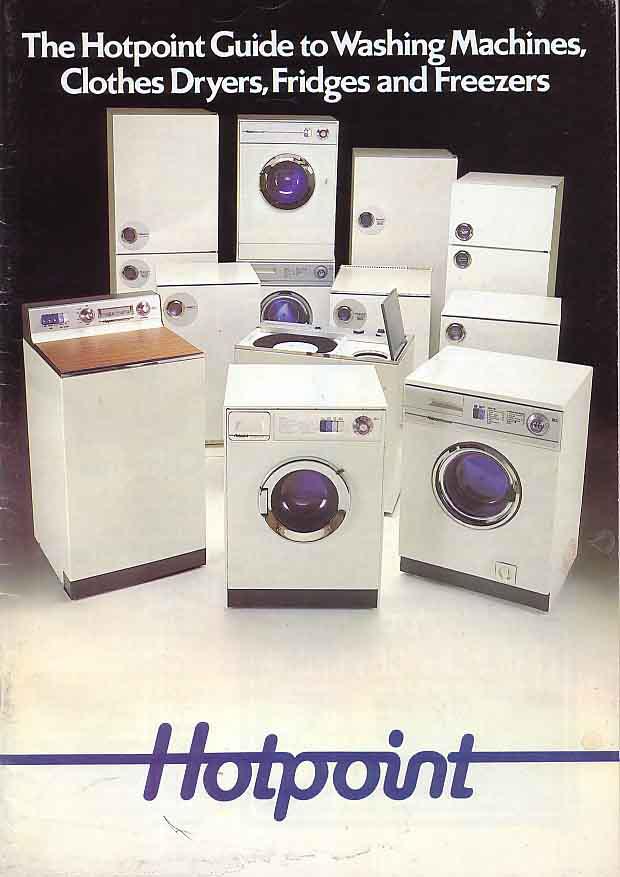
Some twin tub machines spun the washing round in kind of paddle wheel tank whilst others did that jiggle dance let’s twist again with an agitator. And all of these things made different sounds from gentle gurglings to the aeroplane style racket of spin cycles. I stand by my fascination at aged 9 or 10, or 12, or 50. Yet my argument here is that this perhaps certifiable obsession also has a sociological significance for what the 1970s represented was a feast of design, of searching for the ultimate solution, of prototypes struggling to become ideal types. And driving those designs was the need to solve the problems of the time – women working, less time, the small kitchen, new house building with partially then fully equipped spaces for machines, and a new aesthetics. These things not only had to function they had to look right, to fit in, and to give off that aura of desire. This was the apple before Eve and Adam made it Mac.
Back then my maternal grandmother had a large but loosely equipped kitchen. She had, as many did, her laundry days for which she used separates – dragged out across the kitchen floor to be attached to taps and sink. Whilst these machines were housed in cabinets, they barely consisted of more than tubs in tanks that did things to get your clothes clean and dry. I remember she used to have to try and hold the spinning machine down for it would otherwise shimmy like mad across the floor as it spun at high speed with a deafening racket. My paternal grandmother had one of the early Hoover twin tubs installed in a tiny kitchen space that would fill with steam and noise and her cussings of trying to control the thing – water in, water out, slosh, suds, pull clothes from one side to the other then clamp the lid down as the thing took off like the Concorde Aeroplane we saw on TV. It had that dazzling deep blue spinner lid that operated the spinner with hinges alone and consequently terrified as much as it fascinated.
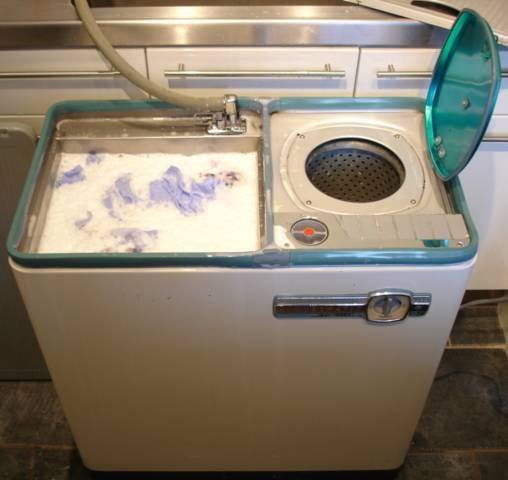
My mother otherwise had this bizarre semi-automatic Hoover front loader which she still had to drag out across the floor. It had this pale-yellow colouring with a lot of blue levers on the control panel. We’d recently moved to a new build house complete with fitted kitchen – ours in a teak effect, the neighbours in a kind of teal green. These clumsy machines were clearly not up to the same level of efficiency, or aesthetics. Freezers were also coming in, often shoved in garages due to lack of room – and the chest freezer with a lid on the top was often so large you could fall in it and freeze yourself alive. My mother, who had a bad back, avoided those and crammed in the upright version. None of the men of course knew what they were doing with any of it besides writing the cheques or signing the agreements on “HP”. Things needed to change.
Like many living in the shire counties, we took our family trip to the annual Ideal Home Exhibition, a giant jamboree of gadgets, mock houses and rooms, and stands with washing machines on them by the thousand. I was in some kind of exhausted wide-eyed child heaven, staring at all these things. Particularly exciting were the “demonstrations” for these machines would not just stand in rows but actually get hooked up to the mains and pipes to be shown to work swirling and whirring sometimes with glass cut outs so you could see parts moving. As I have already stated, my parents had a brand-new house with a fully fitted out kitchen with limited spaces in it to put these things. They chose a Servis model because it was slimline and narrow and would fit in the gap under worktop. It had fashionably brown controls to suit the 1970s. They also bought the dryer to match. Common back then was the stacking system where you put on one on top of the other to save room. There was much household excitement around their delivery that then turned to horror and disappointment. The machine – for ten-year-old me – had a strange plastic smell and curious plastic colour bits in the long sliding dispenser and such. I did not trust it. As it turned out, I was right. It was not “plumbed in” and so whilst fitting under the worktop still had to be pulled out. The machine was so slimline the slightest imbalance in the load would send it toppling and banging across the room. It was clearly designed to be held in place by the cubby hole itself or otherwise became frankly terrifying.
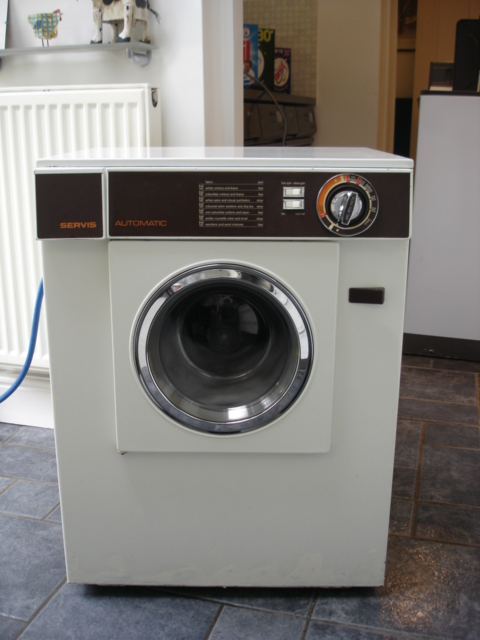
Interestingly, decades later when I had my first job and my first furnished flat to myself, it came with an updated version of the same machine that, as I remember, worked fine though was rather noisy in such a small space. My parents returned the offending model and sold the dryer deemed to be far too expensive on the electric and stuck to the “whirligig” line. They then acquired a slighter bigger Hoover “matchbox” automatic.
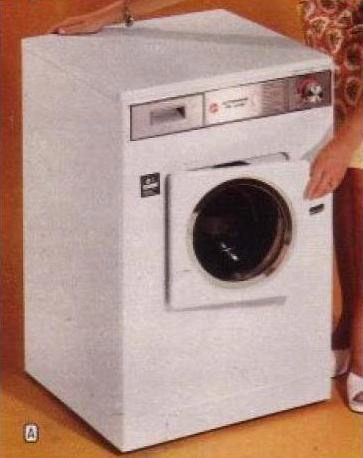
Half the country seemed to have the same model and our neighbours did too only my mother deliberately wanted the hot and cold fill, not cold fill only, version again to save on time and the electric. Of course, now they are all cold fill as this is part of how they maintain their “A” rated wash standard – by taking forever to heat it up and do it. The complaint from all was that whilst it was fun to set the programme – involving ratcheting round a loudly clicking knob on the right that you then pulled to turn on, in itself quite exciting – the whole damn thing took forever. Whilst twin tubs and similar did your washing in minutes these automated machines took hours on end (and you were not given timed displays back then either). Our house was one of many though varied on a small and leafy estate by the river. Other neighbours wrestled differently with problems posed by the new machines. One had the top loading crocodile sort that my mother declared noisy and inefficient as well as a bit unsafe. Others with whole utility rooms that opened onto communal garden space invested in the coordinating purple Hotpoint Liberator range that you could watch as a child from the grass or had that other Hotpoint, the Automatic 1600, that was wide and smart with controls on the top. Friends’ mothers had the Hotpoint top loader that, like its twin tub equivalent, had this cowboy style hat on top of the twisting agitator that you put your powder in the brim and then as the water poured in it shook the whole lot over your bubbling wash. However, the shops were still of full of twin tubs for the luddite though these were becoming far more aesthetic – Hoover had its hinged lids and orange and black trims, whilst Hotpoint went for a prescient 80s look of charcoal and chrome – and worktop style covers were also not uncommon in an attempt to get them to coordinate with your swanky new kitchen.
From the 1980s onwards things got a lot duller and student life does not do much for the laundry. Launderettes held a vague fascination due to their sheer gargantuan-ness that also rendered them utterly lethal (Dryer Killer anyone?) whilst I once shared a house with two guys where the lock had broken so watching your tighty-whities whizz round at 800 rpm with the door wide open was a source of shared hilarity. I also had an American partner whose mother thought we should have a US style top loader. As the one actually doing the washing – not him – I flatly refused. Once finally living alone, I could then decide (with much glee) on the model of my dreams. A re-emergence of an old problem reared its head here, however, as I have never had space for a separate dryer. The development of a condenser (hence no snorkel pipe to play with) and larger capacities rendered the combo approach a goer but not unproblematic. I went for a Hotpoint to tone in with the beiges of my kitchen yet whilst it was pretty to look at it was also pretty hopeless as the pump packed up in under four years due to the tendency of dryers to produce enough fluff to stuff a pillow. Its Zanussi successor was chosen for its removable pump filter and whilst it did not match anything with its yellow and turquoise buttons it was quiet and efficient until the day the door catch broke and it stubbornly refused to accept that it was actually closed for business – so no watching of the spinning tighty-whities with that one. Built-in obsolescence became a factor with such machines as I next bought a Hoover with a bedazzling array of programmes, but felt it was built like a car with bolts loose and not to be trusted. It spun exceedingly fast – the final super whizz was akin to the excitement of putting your foot down in a Ferrari on the motorway at 3 a.m. – but made an aircraft level of racket while it was at it and had to go. Dull though machines have become, I must admit there was some rekindling of excitement about buying my Samsung washer dryer a few years back in graphite grey with the most enormous deep blue porthole door.
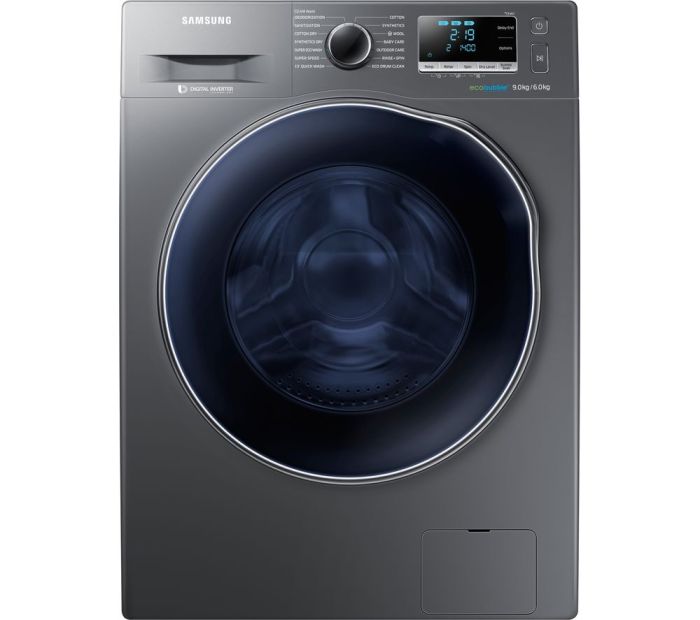
I would not buy the “add wash” version with the kangaroo pouch in which to drop in your forgotten socks, however, for fear of my beloved and curious cat getting caught in it instead. Functionality is not entirely triumphant, though, as it also plays a tune on completion. Despite the high-tech, these machines can still be let down by utter basics – it’s loud banging when spinning was subsequently revealed by a repair man with a bum to die for to be the result of nothing more than loose concrete. I ask you, what next, a computer driven machine that forgets to let in the water maybe? And I’d still like one that actually does the ironing too…
My point, following this overly personal preamble, however, is that this amounts to not mere whimsy and nostalgia rather sociological questions concerning technology and design, aesthetics and economics, and gender and cultural appropriation. None of these machines is yet much good at getting dinner stains out of your T-shirt first time without a shelf-load of stain removers and do men, indeed, do much more of the drudgery than they ever used to? And why do North Americans still insist on jumbo size everything – even to do their washing – whilst the question in the UK remains one of just how stupendously big can one drum get in the same sized box that, simultaneously, no-one even remotely fills to capacity unless their dog, or cat in my case, threw up over the duvet. These factors perhaps coalesce into five key themes: first, the interplay of functionality and aesthetics in design; second, the history of technology in this or of how tub becomes drum; third, questions of cultural variation – thus whiter than white marketing does not work with Muslims; fourth, the links to class, gender and consumption as technology meets drudgery – for women, primarily; and fifth, the shifts between advertising and appropriation as the use of all of these things is far removed their streamlined and modern ideals from sweltering steam to watching those tighty-whities. There are of course other factors – architecture, questions of how cultures live individually or collectively, and not least the technologies of detergents and the stuff you put in them from suds and crystals, to pods and caps, and those relentlessly pink stain removers…
 The Cat's Meow