The Y O Y Factor

Toxic masculinity is a con trick of a concept that deflects attention away from the causes of some men’s behaviour and which obscures wider and deeper explanations of what is happening.  Concerns relating to masculinity have inculcated a string of mediatised terminology over some decades – from the new man to new lad and from the metrosexual to the existential, or not, crisis of masculinity.  As I have attested elsewhere (Edwards 2006) the latter idea is a woeful muddle – are all or some actual men in crisis and if so a crisis of what, self-esteem or poverty; or is masculinity as set of ideas sticky note posted to males in some kind of disarray, devalued, or negative?  Or all of this?  The haze is closer to a complete fog.  And some historians have queried whether this already dated idea is new at all (Kimmel 1987).  Whilst the origins of metrosexual terminology are reasonably clear given Mark Simpson’s postulating of a description of metropolitan narcissism in the 1990s (Simpson, 1994) the rest is frankly a muddle.  And a mediatised muddle.  So, we shift from discussing David Beckham’s fashion sense to the now near defunct Loaded lifestyle magazine, and – as of this month – BBC documentaries concerning the internet “manosphere”.  James Blake presents this.  A bit of a hottie if you ask me – and not surprising he is used here – not to be confused with the singer songwriter he’s rather a TV presenter in the style of Stacey Dooley for BBC3.  Such TV amps up the concern, or more cynically hysteria, over issues to get ratings and attention – and there’s clear inflexion of the North American in this which is whence the mythopoetic men’s movement and wider polemics on “the crisis” come (Bly, 1991).  Even women, North American ones, get in on the act so Susan Faludi’s critique of an anti-feminist “backlash” is resurrected in the wake of her volte face concern with “stiffed” men (Faludi, 1992, 2000).

Yet my cynicism here masks a deeper concern for this is not simply mediatised nonsense.  David Szalay has recently won the (was “Man”) Booker prize with his novel Flesh (Szalay, 2025).  It tells the tale of István, a Hungarian teenager then man whose life blows along rather like paper bag in the wind from disaster to success and back again.  Anchoring it are references to sex, his physical-ness, as a constant given his psychological and emotional life are deeply repressed, hidden even, through the flat yet close third person narration.  He does “bad” things, such as – in the first instance – getting into a fight and accidentally killing someone following his emotionally confused affair with an older woman.  Or rather one might say oppressed given it is the woman who refuses his declarations of love.  Szalay’s highly accomplished writing performs certain tricks – first that we learn things late, or suddenly, in offhand ways – such as his loss of a friend in the Iraq war or indeed that he fought in the Iraq war – whilst the chapters, long but pacy, are separated by blank pages where one learns in the next one that István is somewhere different but we have no tale of how he got there.  It’s ingenious.  It’s also symbolic and, if you allow it to, it will reduce you to near tears as – as they say – it’s all in what’s not said not what is.  What it symbolises and expresses is key to my concern here.

The Guardian, doing what the Guardian does, has latched onto the novel as a description of “toxic masculinity” and Szalay has spoken openly of his jitters concerning such as it were “woke” interpretations.  Yet toxic masculinity fails to explain the story of a fictional Hungarian let alone where men are at whilst the novel itself has a lot to say about life in the twenty first century.  I will return to this.  The toxic masculinity story, meantime, goes as follows.  Young (in particular) men are turning to the online manosphere and antifeminist rhetoric if not practice as masculinity is in crisis.  They seek toxic masculinity – hard, repressed, anti-feminist, aggressive, misogynist – as a solution when what they need is good male role models.  Interestingly, metrosexual Beckham is a primary example, good looking, in touch with his feminine side, a family man, pro-gay, etc.  Except he is silly level wealthy.  What also feeds into this is the wider concern with the influences of social media and the internet, the same neurosis that underpins a myriad of parental led campaigns about children needing protection from pornography, unrealistic imagery, bullying, and hate speech from the likes of Andrew Tate.  Tate is a media star, or near avatar, of what one might call “anti-woke” sentiment from promoting money making and kick boxing to misogynist and homophobic commentary or “advice” given through social media platforms.  Similarly emblematic of this “toxic masculinity” is Donald Trump who needs no introduction.  The solution it is argued, lies in countering the anti-woke with woke – the homophobic with the pro-gay, the anti-feminist with the pro-feminist, and so on – and for young men to have better role models.  Parsons – him of the nuclear family system where men are instrumental and women are expressive (this is their “function” as “socialisers”) – would be proud (Parsons, 1949).

Let us get back to Szalay’s novel.  Implicit in this, if not explicit, is a critique of the neoliberal agenda which reduces our lives to a model of individual choice.  As sociologists and others well know, this is patently false.  You cannot choose a big house, to drive a fancy car, or even get the means to either if you are poor, live in the wrong place, and can’t even get the education.  Decisions are social and structural not willy nilly expressions of an inner moral compass.  Such whims were repeatedly given legs via the “it’s your fault if you are poor” understanding – or rather ideology – of poverty that has existed for centuries.  Margaret Thatcher, and a host of others, gave it arms, a head, and a heart to run with – so the poor(er) blame themselves, feel guilty, and get stigmatised nonstop by the world around them.  Bauman has blasted this apart repeatedly as we are either “repressed” and cannot have that which society deems normal or we are “seduced” into consumerist addiction trying to get it (Bauman, 1998).  Similarly, István’s emotional autism – or more simply numbness – is perhaps better explained as a shutdown to the pain inflicted upon him rather than some inner psychosis.

Toxic masculinity is not even a psychological condition.  It does not exist outside of media, and “impact” hunting academia, at all.  Yes, some men – Trump, István – do horrible things but we are avoiding where they are getting it from.  The recent Eastenders story line of how a teenage boy ends up hospitalising his stepmother due to the “dark web” of the “manosphere” similarly distracts.  He is poorly educated and working class and – more to the point – neither parent is properly capable of emotionally communicating with him.  Similarly, Kat Slater struggles with her son but makes a better job of it.  Yes, individual upbringings come into it but diffuse, confused terminologies of gender and masculinity evade the all too obvious consequence that this is what happens when there is no job security, too many have too little opportunity, and there is no safety net in too many cases.  And, alternatively, others become populist narcissists drunken and deluded to the point of criminality on their own grandeur.  Guess who.  In either case, the issue is the lack of infrastructure of any kind to keep this in check.  Late, high – or whatever terminology you want to give it – capitalism, as premised upon neoliberalism, defined as a “rolling back” of state provision whilst increasingly using the state’s legislative powers to control and oppress all and any forms of opposition to it, is key.  Hence the polity collapses into the economy and politicians are entrepreneurs and the shots are called by global CEOs.  Seeing Trump, or whoever, as an outcome of “toxic masculinity” is – as if to pull down a veil – to miss the point.

The other side of this conundrum is women, or rather femininity, or rather again “commodity feminism”.  Goldman and his colleagues coined the term in the 1990s and they and others have extrapolated upon it since (Gill, 2008; Goldman, 1992; Goldman, Heath & Smith, 1991).  The term is a play upon the Marxist concept of commodity fetishism or the ways in which the marketized values given to commodities mask their significance as the products of capitalist relations.  Goldman initially illustrated this through an analysis of a late 1980s advert for the VW Golf car where a woman dumps the fur coat, the ring, and other symbols of “male” ownership and heterosexuality yet keeps the car (and her independence).  Thus, the concept has primarily focused upon Marxist or neo-Marxist studies of advertising and consumer culture.  Baudrillard’s extensive analysis of the collapse of all social meaning into the “commodity form” also underpins much of this (Baudrillard, 1993, 1998).  Put simply, feminism and more populist ideas of women’s empowerment are, as it were, “co-opted” to sell stuff.

My point here is this process has expanded and developed to a point where it saturates the entire mediatised world of popular culture.  Women’s empowerment is now less a statement on their oppression and more a commercial slogan underpinning everything from TV programming to music, film, and media analysis more widely as it “chimes in” with the wider theme of “woke” politics as already outlined.  Examples of this proliferate exponentially from the music of Sabrina Carpenter and Taylor Swift, to more or less all TV shows featuring Suranne Jones, let alone the legion of soap operas and dramas dominated by female interest story lines.  The legacy of the likes of Sex & The City and Desperate Housewives let alone Killing Eve or The Handmaid’s Tale is immense here.  The attempt to represent female empowerment against the odds, or indeed toxic masculinity, is at near epidemic levels in the UK with – in particular – an endless string of mini-TV series involving increasingly fantastical plotlines centred on gender (The Guest – where a poor white female thwarts a rich white male with the support of a rich white female is a recent prime example).

Presenting women as strong female leads is important in counteracting the centuries old legacy of the male gaze as famously outlined in the work of Laura Mulvey – men do stuff and women get looked at – yet, more insidiously, the attempt to challenge this has become co-opted into some marketized con-trickery where women suddenly get away with murder, sometimes literally (Mulvey, 1975).  This deflects attention away from the empirical realities where, whilst much has improved, women are not equal in the workplace, remain the targets of violence and abuse, and are still – or perhaps even more – judged on their appearance.

Toxic masculinity turns much of this on its head to assert that hegemonic culture is increasingly female-centric and excludes, devalues, and misrepresents men.  There is a point of sorts here – for example, Mr Muscle whether as advert or wider representation, plays upon a trope of men as simply useless – yet it’s less this issue of (mis)representing masculinity that is at stake here rather the fact that it obscures the structural oppression of women and systemic gender inequality as a mechanism that underpins the lives of men and women alike.  There’s no lack of positive images of masculinity around from athletes to pop stars, film stars and characters to more politically conscious businessmen, or David Attenborough.  Thus, whilst discussions and critiques of toxic masculinity appear to empower women and feminism, or highlight men’s suffering and needs for support, they effectively deflect the entire portrayal of gender relations into a marketing device to promote a TV show, a car, or popular culture more widely.

This is easily read as a sort of clumsy Marxist critique of capitalism, yet it is more a statement on its contemporary hyper consumerist, hyper individualised, and mediatised form.  We are constantly encouraged to view any and every difficulty through the lens of a neoliberal model that renders all and sundry not only as individual rather than structural but as a mediatized, consumerist, “topic” to market, sell, or even discuss in limited terms.  In turn, this is not new yet centred on the de-regulation of markets to include so that everything from soap powder to spiritual awakening could be “sold” – hence “pink washing”, or slap a rainbow on a jar of marmalade to make out the manufacturer is a supporter of LGBTQ rights, or similarly “greenwashing” where terms such as sustainability and fair trade are thrown around with such wild abandon to incorporate everything from coffee plantations to polyester (yes, really) they become utterly meaningless and reduced to mere marketing tactics.  Thus, here men’s violence against women becomes the focus of selling a TV show or a discussion point in the press on “toxic masculinity”.  As Richard Dyer once wrote, masculinity is rather like air, constantly there but almost impossible to see (Dyer, 1993).  It’s also now increasingly another mediatised concept that confuses discussions of how people, and perhaps particularly some groups of men, are just plain lost.

The more appropriate concept of use here is, perhaps surprisingly, Durkheim’s idea of anomie.  Anomie relates to a state of normlessness, of difficulties in knowing right from wrong, or just making decisions, a lack of social glue…  He highlighted not simply the decline of organised religion or rise of science and secularisation here, rather the shift in solidarity (the glue) holding society together as we moved from a world of commonality and sameness into one of complexity and difference.  It’s an idea that points towards the impact of globalisation and its contradictory tendency to promote diversity whilst collapsing into a McDonald’s in every country.  For the factor missed here is that diversity is itself a strategy of selling what critical Marxists called pseudo-individuality (Adorno & Horkheimer, 1973).  Or, to put it another way, a string of detergents that take up an entire aisle in the supermarket yet are owned by a mere two companies when all do the same thing as stuff to stick in your washing machine.

Let us return to István.  Istvan’s decisions and life course centre on the need for immediate gratification, yet rather than greed what this implies is simply an issue of survival – of finding the means to live and enjoy stuff at least some of the time.  His education and situation are poor – his assets are physical and fleshy – he is strong, can fight, and work as a bouncer, or get sex in an opportunistic sort of way – women seem to fancy him and come on to him.  His life blows along, as I have said, like a brown paper bag in the wind, from Hungary to the Iraq war to London security firms and dodgy dealers, from rags to riches and back again.  What punctuates this is his sexual relationships with women and his physicality.  This is the one constant, hence Flesh.  The story turns full circle.

He commits occasional acts of violence and is near monosyllabic throughout – an implied autism perhaps – saying “OK” to nearly everything.  To read him as an example of toxic masculinity, however, is way off point.  His wealth extends from an act of gallantry, he does not shirk work, and clearly loves his son, whom he loses suddenly.  He is alienated and lonely.  He also remains devoid of assets that are his own.  The issue, to return to where I began, is that life happens to him not him to life.  His life course is almost entirely not under his control and extends from consequences he cannot see.  As such, it is a damning indictment of the neoliberal maxim, or bullshit, “life is what you make it”.  It’s also believable – resonating as a tale of anybody who is nobody – which is precisely the point.  Concepts such as toxic masculinity do not explain István, men in general, or the twenty first century.  They are a gross – and arguably deliberate – distraction from what is in plain sight.  Shit happens – to some, mostly poorer, people more than others – and rarely through much fault of their own.  Others profit, lie on sun loungers and rip off everyone else largely because they can, and they get lucky.  We laugh at them in thrillers on TV where they seem to come unstuck, note seem.  This is, in essence, the nature of the twenty first century.  Not chromosomes.  

 

References

Adorno, T. W. & Horkheimer, M. (1973) Dialectic Of Enlightenment, London: Allen Lane. 

Baudrillard, J. (1983) Simulacra And Simulations, New York: Semiotext(e) (orig. pub. 1981)

Baudrillard, J. (1998) The Consumer Society: Myths And Structures, London: Sage (orig. pub. 1970).

Bauman, Z. (1998) Work, Consumerism And The New Poor, Buckingham: Open University Press.

Bly, R. (1991) Iron John: A Book About Men, Shaftsbury – Dorset: Element.

Dyer, R. (1993) The Matter Of Images: Essays On Representation, London: Routledge.

Edwards, T (2006) Cultures of Masculinity, London: Routledge

Goldman, R. (1992) Reading Ads Socially, London: Routledge.

Goldman, R., Heath, D., & Smith, S. L. (1991) “Commodity Feminism” in Critical Studies in Mass Communication8(3), pp. 333–351. 

Faludi, S. (1992) Backlash: The Undeclared War Against Women, London: Vintage.

Faludi, S. (2000) Stiffed: The Betrayal Of Modern Man, London: Vintage.

Kimmel, M. S. (1987) “The Contemporary ‘Crisis’ Of Masculinity In Historical Perspective” in H. Brod (ed.) The Making Of Masculinities: The New Men’s Studies, London: Hutchinson

Mulvey, L. (1975) “Visual Pleasure And Narrative Cinema” in Screen, 16, 3, pp. 6-18. 

Parsons, T. (1949) “The Social Structure of the Family” In R. N. Anshen (ed.), The Family: Its Function and Destiny, NYC – New York: Harper (pp. 173–201)

Simpson, Mark (1994) “Here Come the Mirror Men”, The Independent, 15 November

Szalay, D. (2025) Flesh, London: Jonathan Cape.
The XX Factor

“It must be nice to be a man and make boring music just because you can”

(Florence Welch)

When discussing tastes in music, I am often asked by friends as much as strangers why I like so many female artists.  I have reflected on this over the years and rather come to the conclusion that the answer lies in the question itself.  Yet, to attempt to answer it in its own terms, it is true I do like a lot of women singers yet there are a lot I do not like and quite a few men I like or have liked in similar ways.  As I will also argue, there is a lot more to this than a matter of personal taste.

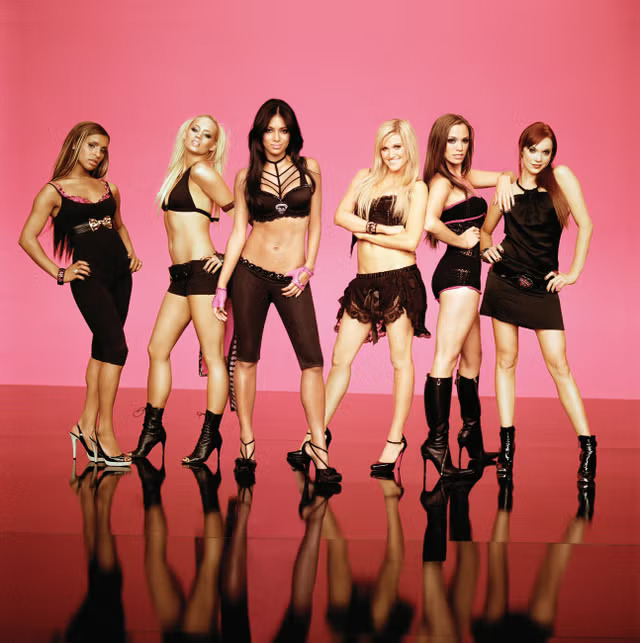
To start with the more personal point, I generally loathe vast swathes of what now constitutes female pop or, more particularly, girl group music – particularly in the twenty first century – the kind of hyper-sexualised gyrating that underpins artists as diverse as Girls Aloud and Destiny’s Child.  The former, along with the Pussycat Dolls, All Saints, Sugababes and many others, tend to represent a partially or wholly male-manufactured disco pop selling of sex.  They may or may not write some of their music, but the emphasis is still placed upon a particular dance-esque style of presenting that has its roots in a lot of Motown groups and similar musical phenomena of the 1960s and then, perhaps more than anything or anyone else, Madonna.  Scantily clad, most of these artists drone on about how they fancy some bloke, don’t want the attention of some other bloke, or generally – to quote Kylie – can’t get blokes out of their heads.  Kylie, interestingly, is a little different.  Whilst sexy in a sort of coquettish way she is rarely fully “sexualised”, it’s too camp and too silly, attuned to the longevity of vaudeville in constructing femininity or, to put it another way and as once self-titled, she is a showgirl from her feathers to her kitten-esque heels.  Madonna, circa the 1980s, was a good deal more aggressive and much of her work at this stage was often confrontational of the male gaze.  Compare this with the imagery of the Pussycat Dolls twenty odd years later and the pornographic takes centre stage with slashed skirts, acres of flesh, and yes, those sky-high spikes for heels.  And that’s before you get to the lyrics of “Don’t Cha” wish your girlfriend was a slag like me.  My gross sexism here is intentional for what is illustrated here is just how far feminism in music has descended into what I would call a pit of neo-liberalism.  So, the argument goes that “I can act like a stripper in an appearance derived from pornography created by men for men but, because I chose to, it’s liberating.  And because I might still reject you when you come on to me, it’s empowering.”  The same muddle besets the likes of Dua Lipa whose songs critique male behaviour whilst she otherwise gyrates and presents in a highly sexualised way.  Also interesting to note here is that the prime consumers here are not straight men at all but either women following the same logic or gay men who’ve long since held up sexuality as liberation and the joys of clubbing.  There is nothing wrong with either, particularly when you are part of a marginalised group that has been oppressed for centuries, but there is something jarring when you are only doing what men wanted and constructed in the first place.

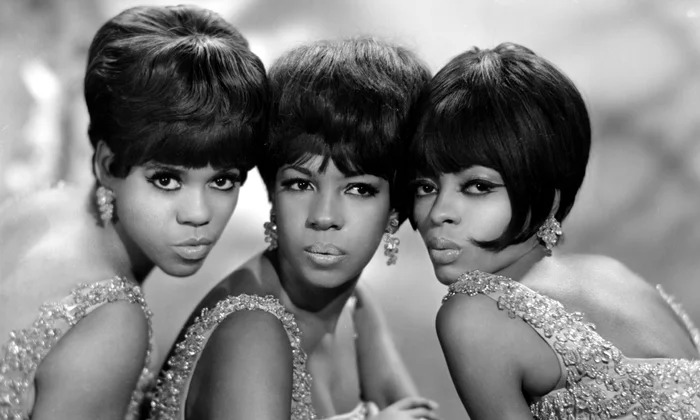
There is a history lesson in this.  As is well-known, the world of rock and pop – as well as classical and jazz forms of music – is primarily founded upon male writers, male producers, and male record company managers.  Women have historically tended to be slotted in here as – at best – singers and sometimes songwriters, particularly on the theme of civil rights (Nina Simone) or as front women for the American song book (cue the likes of Ella Fitzgerald and Billie Holiday).  The rise of Motown would do much to put women centre stage – particularly in the case of Diana Ross and the Supremes – whilst writing and controlling them from behind the scenes.  The folk movement was important in shifting attention more towards the female solo artist as a songwriter as well as a singer, particularly in the case of Carole King and Joni Mitchell, yet this was not normalised until the 1970s.  Women doing anything more than dancing and singing as subjects of the gaze remained marginalised until later still when a slew of female performers and writers across differing genres would emerge from Chrissie Hynde and Cyndi Lauper to Kate Bush and Annie Lennox.  Whilst the music they produced was diverse, the tendency to still position them as objects of the gaze and or to position their songwriting as somehow stereotypically feminine, would remain.  This has shifted remarkably in more recent years yet the very long and entrenched legacy of presenting, or perhaps more accurately pigeonholing, the female in music as the singer of personal pain, particularly in the form of the torch song of unrequited love, would remain.  Thus, whether you like “women’s music” has much to do with how you react to that genre.

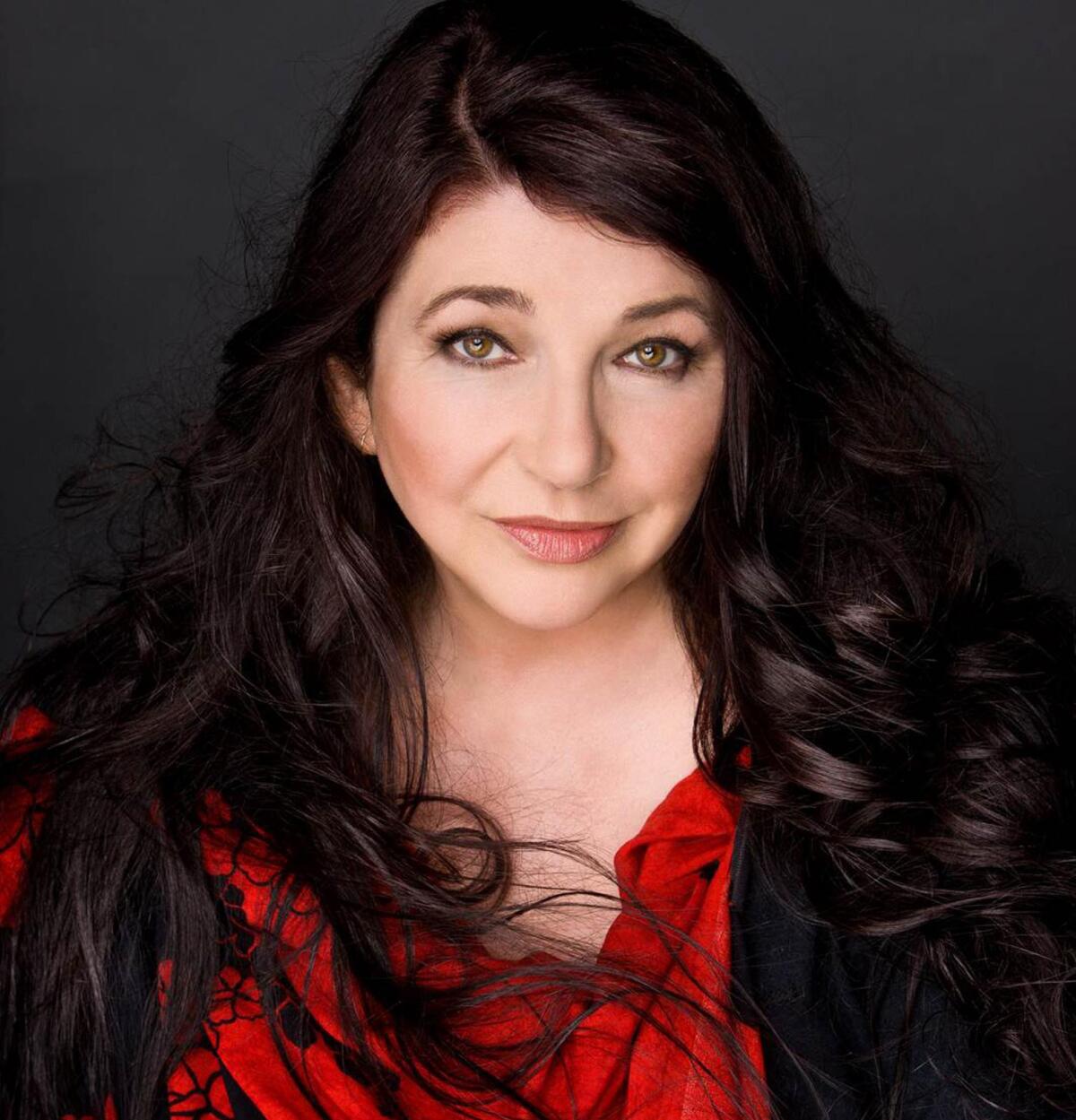
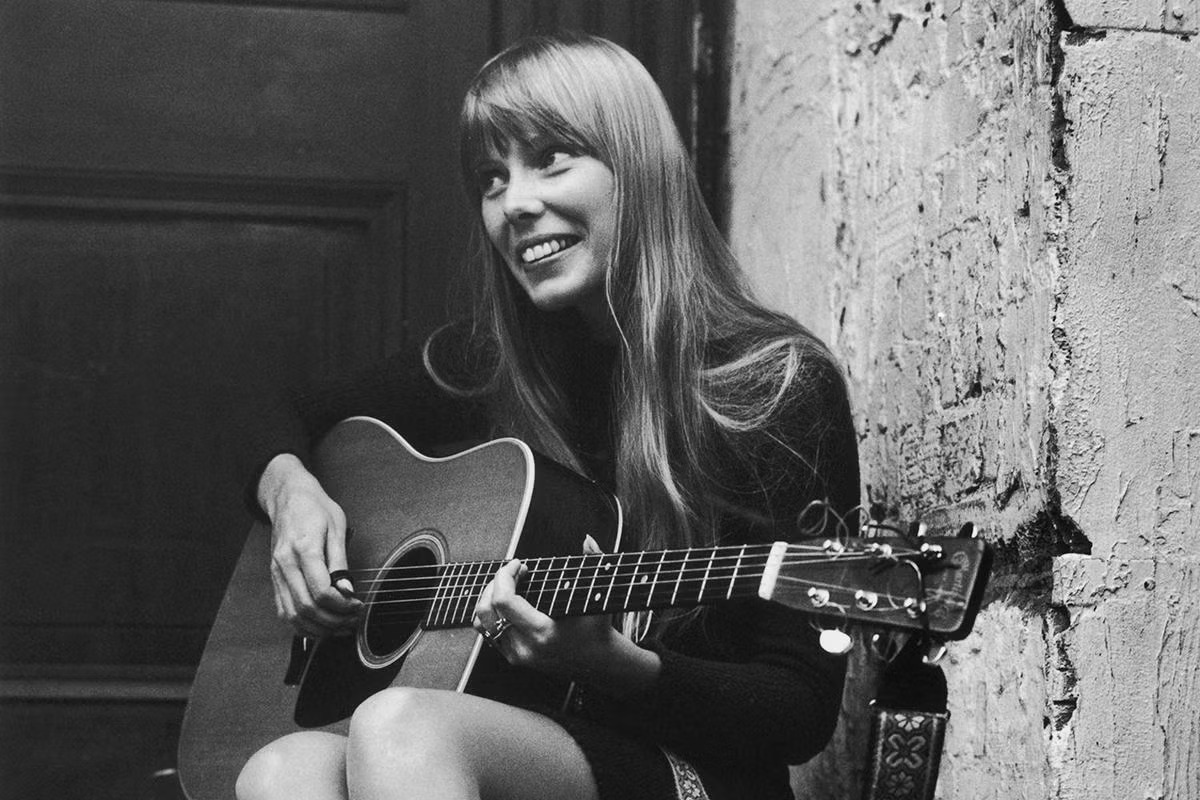
To return to my more personal account, my admiration is for songwriters far more than singers.  Thus, the top gongs go to the likes of Kate Bush and Joni Mitchell plus others – these self-producing, self-writing, world of their own creating musicians for whom critical acclaim often came late.  Kate was five albums in before the majority took her seriously and Joni is still living down the “white goddess of folk” label to this day.  Their nearest male counterparts – David Bowie in the UK and Bob Dylan in the United States –conversely held godlike status for nearing half a century, despite the fact that neither had the musicality of their female counterparts – yet I will return to this more vocal issue later.

So, you might say, much of this is politics.  As a child of the 1970s and 1980s, versed in women’s liberation and later academically trained in sociology, I do not – however – fall for mere marketing.  Cue Beyonce.  Yes, she can sing and, dare you ever forget it, she is black and “fierce” and she even challenges the odd stereotype like country music is for white girls or deconstructs drum and bass, yet she does it whilst dressed in little or little that isn’t seriously “designer”, and sells everything from makeup to whisky in the name of her brand on the same website that sells her records.  So, one might conclude, she is a talented singer that undoubtedly writes and performs some banging tunes and is without doubt a businesswoman (bizarrely the term business person still does not catch on in this world of Apprentice type females for whom lip gloss and heels are key parts of their self-proclaiming success) yet this pivots, as with Taylor Swift, on a banding of egoism and branding that is as neo-liberally deluded as it is American.  In sum, the music is but a small part of it.

Interestingly, singer songwriters – even if female and even when the music does matter – do not always convince me either.  The 1970s onwards were littered with Mitchell-esque wannabes from Judie Tzuke to Tori Amos, and from Julia Fordham to Alanis Morrisette.  They have their moments and, in some cases, a startling start, yet the tendency of far too many to collapse into a solipsistic “me me me” of whining does not amuse me.  Even when it’s sometimes meant to be funny.  So, more recently, Self Esteem’s choral “feminism” never steps far from the zone of the self-centred in every sense and Chappell Roan and the like, whilst edgy, are just – well, not quite edgy enough.  Commodity feminism looms here on all levels.  Hence Taylor Swift has made a billion out of talking about herself.  At enormous length.  Thus, the ones that don’t impress the most.  St Vincent shifts gear with every record and plays a mean electric guitar so, again, it rises above mere ego, and no-one really knows quite who Annie Clark is at all – it’s a persona all the way so when she dresses up in PVC like a sex doll and performs songs about sex and seduction, it’s not actually her rather some kind of dramatic irony.  Similarly, Joan Armatrading has always done a lot more than tell tales of hurt whilst strumming a guitar.

Yet, to get back to the point, as is well known, many a gay man (and I am one, sort of) loves a diva yet for me bellowing to the back of the hall in a glittering gown does not cut the mustard much either.  Whilst some are distinctive, Diana Ross and Dusty Springfield particularly, far too many are relics of that bygone age for me where men wrote the songs that women sing and most of that boiled down to bewailing being dumped or perhaps on the dig for gold.  Eartha Kitt’s Black-and-Decker purr was a case in point or Nancy Sinatra’s similarly feline perfection.  I will admit I did like that a lot more; it was fun.  North America again looms large here whether in the form of the original gospel hollerers Aretha Franklin and Whitney Houston or other ear wigglers like Celine Dion, admittedly French Canadian, or Mariah Carey.  Yet torch song touting in the twenty first century – this time in the form of something nearer to a self-confessional – would return in the form of Adele, a one trick pony if ever there was one.  Thank the lord for the Vegas funeral pyre to which most of these aural assaults end up.  I am not keen.

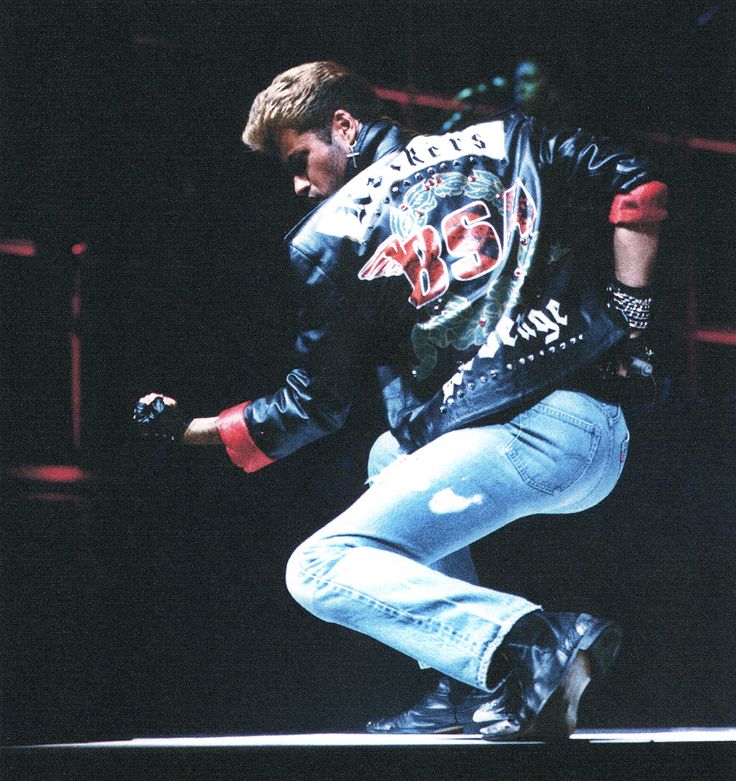
It should be clear by now what I do not like which begs the question why I like what I do like.  And, in particular perhaps, the role of the voice.  I have always liked a high note and, as a male of the species where one mostly loses the ability to hit them, that also becomes a source of admiration in itself.  Of course, some males hit a high note too in falsetto – Russell Allen Thompkins Jr of the Stylistics was fantastic at it, and then there was Jimmy Somerville, and now we have the wonderful Jakub Josef Orlinski, a counter tenor who could near match the castrati and an interdisciplinary genre busting breakdancer to boot.  Darren Hayes, of Savage Garden fame, is another who can hit a high note.  Even more extraordinarily, Venezuelan Samule Mañero is a soprano, a male one, though he does don the odd dress.  Singing styles and voices are a deeply acquired taste – my dad complained that most female ululating top c hitters hurt his ears whilst others like growlers.  Interestingly, I like the whisky and coke gravel of Stevie Nicks (also a songwriter not just singer) or indeed Kelly Jones (again songwriter as well as singer of Stereophonics) or Richard Marx (both male!).  And yes, and so, I do like some men, with a passion.  The two most notable being George Michael (another tenor from heaven) whom I was both in love with and lusted after relentlessly and Peter Gabriel, the only true rival to the crown of Kate Bush.  His third and fourth albums are widely regard as two of the most groundbreaking of all time.  Another Michael, namely Bublé, can also “buble bath me” (to quote Jack Whitehall on the Graham Norton Show) anytime.  George Michael and Jimmy Somerville do of course also stand for a form of unashamed gay politics which – to be consistent with my views on the women – I champion more than the whining of Will Young and Rufus Wainwright.  So, interestingly, whiners whether male or female do not do it for me.

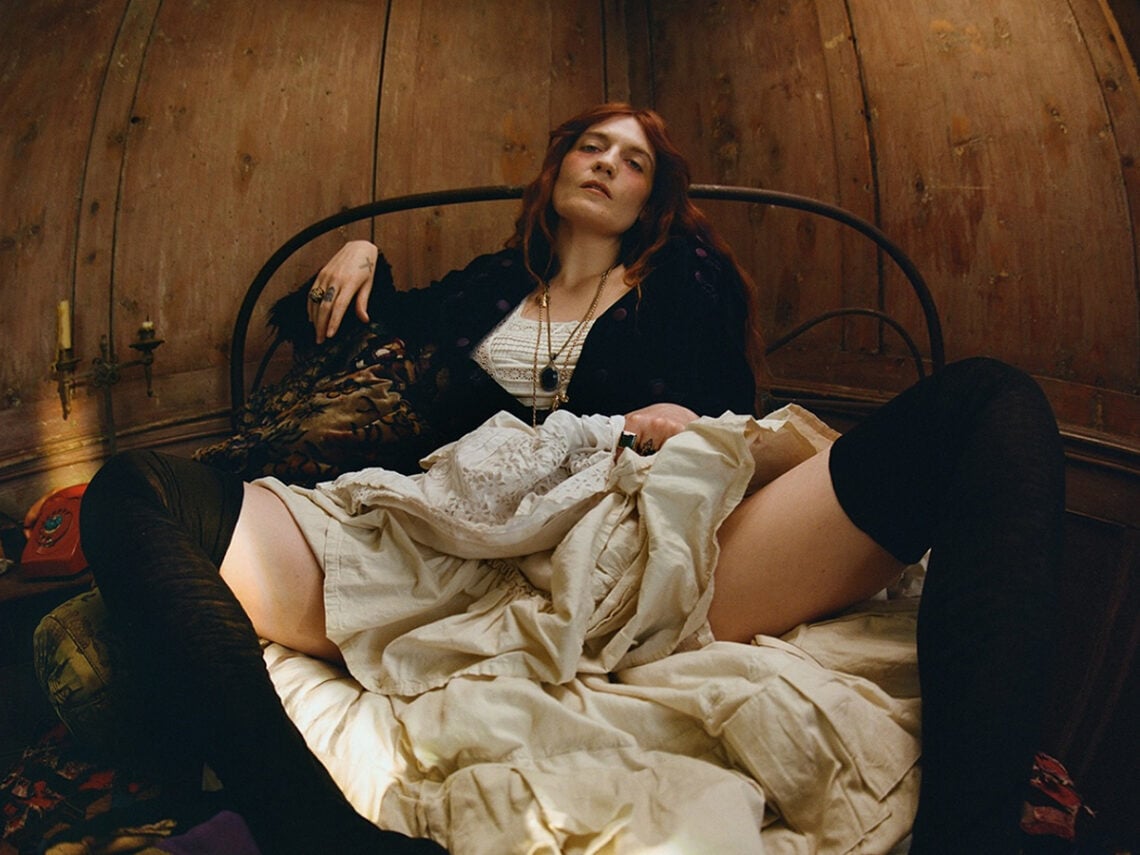
Yet perhaps there is a note to be wrote on the sound too.  Several friends I have chatted to on this matter have said they do not find the female voice so pleasant.  It perhaps lacks the same gravitas or power.  For a heterosexual female listener this might also become a source of attraction (hence my mother’s playing to death of Neil Diamond) whilst heterosexual males do not seem to get into female voices unless, perhaps, they are either male level powerful or sound orgasmic.  However, I wonder if this is purely an aural concern.  I have the lingering sense here that the female sounding is simply not taken so seriously for it sounds feminine and, as all we good feminists and sociologists know, the feminine is seen as weak and degrading.  A linking factor here is that women of more feminist conviction may also find displays of the feminine rather grating.  Yet equally this expression of “what it feels like for a girl” may become admirable and more so for its connection to suffering.  Whether womankind simply suffers more than mankind is perhaps open to debate, but it’s rather as if the female listener is sometimes less inclined to be reminded of all that than the gay male for many gay men finds the howl of female angst arresting.  Many women artists now also do far more than wail in pain – US R’n’B has long been “sassy”, others observe or have punk-like overtones, and some – like Florence Welch – have enormous charisma, and indeed power.

The issue of sexuality also plays its part here for whilst some woman may not like listening to female whining, the heterosexual male appears positively suspicious if he does – like effeminacy, it raises questions about his masculinity.  Hence, women singers may or may not be liked by other women, will rarely be the number one choice of men, and only a minority – gay men – tend to have a stronger affinity with them whereas conversely the men don’t cause problems for the straight men, are admired by some women, and fancied by some gay men so often times it’s a bit of a win-win for the men and not the women.  What this in turn raises is a wider question of marketing.  To return to where I started, women and men tend, not exclusively, to produce different kinds of music.  Softer, folksier and generally more emotionally intimate music – and more simply “pop” – has been the preserve of females whilst males, though sometimes dipping their toes in these areas, have historically had a wider repertoire including more that is aggressive, political, and hard as the word “rock” connotes.  There are of course crossovers, yet the exception tends to prove the rule in the case of punk females or the more confessional worlds of some men.  The question of whether women and men necessarily want to produce such music is perhaps open to question – rather that is what they will get record contracts to produce, so that is what you will hear, and what will be distributed more widely.

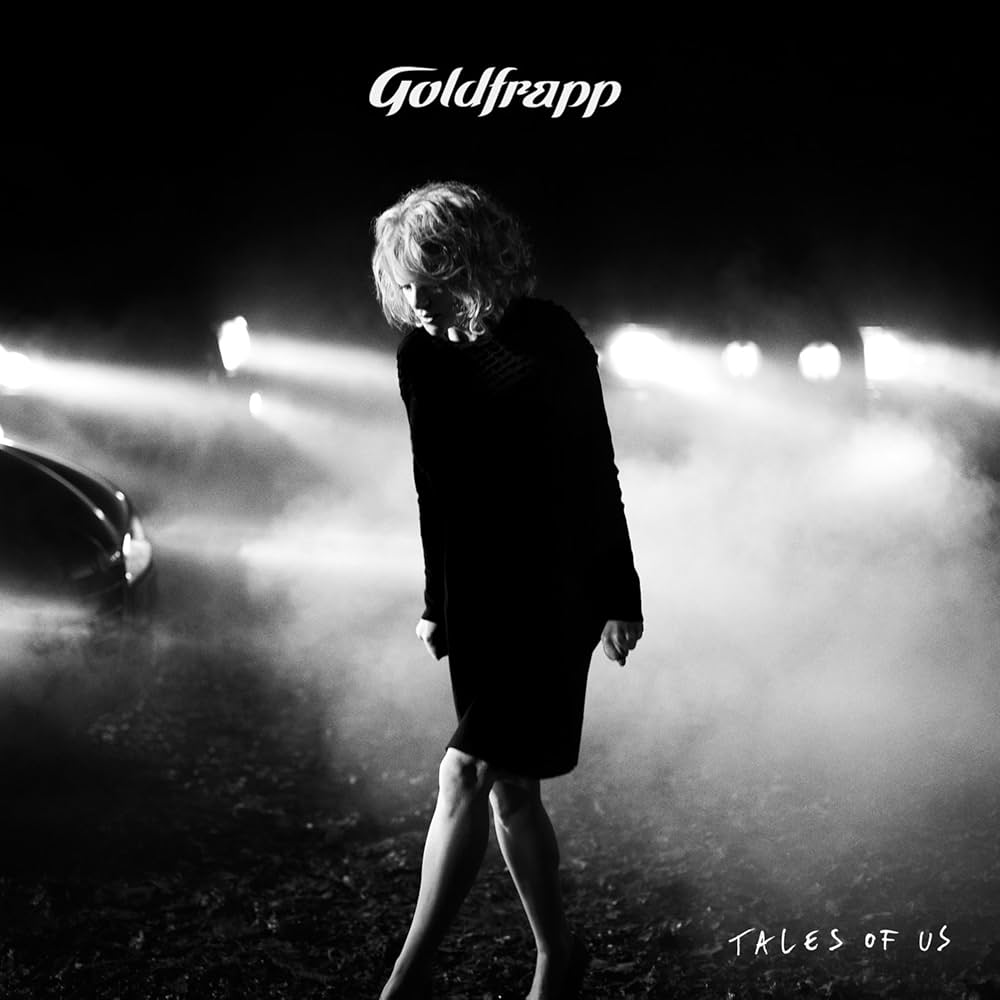
None of this explains, necessarily, why person x likes y and person a likes b, though part of being a teenager is avoiding ridicule.  As I was a teenager in the 70s and 80s, I have never forgotten how lads, particularly in groups, would routinely castigate anything and everything perceived as sissy, soft, or – more simply – feminine.  Part of the derision that underpinned Abba’s career, until they had the last laugh, was that it sounded – and was – a good deal more feminine than its new wave, punk, or even new romantic and electronic pop contemporaries.  That said, I guess I also need to somehow try to explain why I find (some) women’s music so appealing.  Some of my favourite albums are indeed by women.  What I am less sure of is whether their woman-ness is why.  They include Kate Bush’s Aerial.  I have never to this day forgotten going out in 1978 to get The Kick Inside on vinyl, putting it on my parents’ record player and within minutes finding myself tumbling down some kind of Alice in Wonderland rabbit hole never to escape in nearing fifty years – the sheer weirdness of it, the way her music envelops you, these worlds she create – yes, part of this is very female, not least her voice but it’s the creativity of it, its completeness as a mode of expression, and on occasion at least, the cleverness of it.  Who else thinks up songs about Hitler’s sex appeal, the plight of a foetus in a nuclear war, or indeed expresses grief through an account of doing the laundry.  Aerial took the domestic and the mundane and made it a profound exploration of both loss and an affirmation of life.  In observing something as basic as bird song.  She is, was, and always will be – a total one off – able to invent what you could not think up or to make the ordinary utterly extraordinary through lyrics, music, production, and performance.  That is not defined by her femaleness.  As previously mentioned, Gabriel at his best is similar but there are very few men who get anywhere near it not because they are men but because well, they just don’t.  Another is Joni Mitchell’s The Hissing of Summer Lawns.  What I heard back then, and now, is again an extraordinary ability to conjure something up that, in particular, expressed the complexities of humanness from the self-destructiveness of drugs or social climbing through to the realms of spirituality and wonderment.  The complexities of Californian life are rendered dystopian and cinematic.  Once more I am not sure what her femaleness has to do with it – it’s rather an anti-women record in parts – yet perhaps it requires a slithering in and out of vulnerability that males tend to find harder to do.  I don’t know.  What appeals is partly that cinematic quality and I’ve a strong love of film.  This underpins another choice, Goldfrapp’s Tales of Us.  Here femaleness does play a strong part – Alison’s breathy, evocative vocalising to the point where the words themselves near disappear lends itself once again to the creation of whole emotional worlds – the characters, drawn from literature and film are one way or another in turmoil and torment.  Yet, the twist – a female one – is that this is not mostly expressed in ways that are violent or aggressive, rather strange and quite extraordinarily beautiful.  And the other half of Goldfrapp is of course a man, Will Gregory.

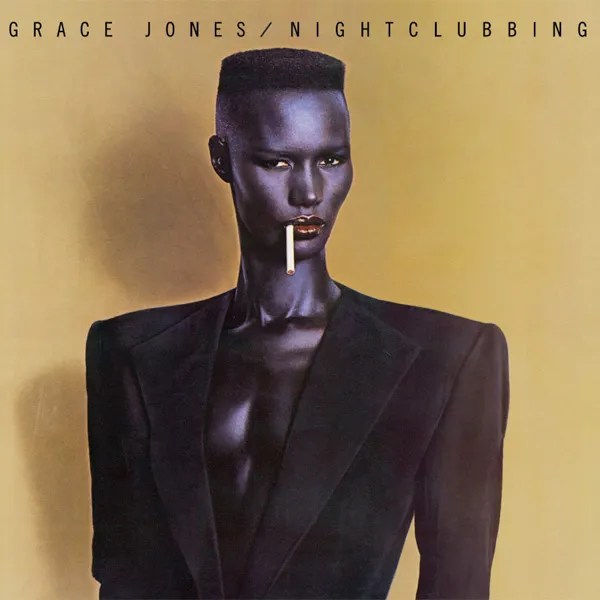
So, what we have here is a repetition of themes around emotionality, strangeness, and the cinematic.  I also rate Gabriel’s third and fourth albums, for their sheer drama – indeed downright scariness – as mentioned before.  Similar themes underpin the superbly dark qualities of Massive Attack’s Mezzanine.  My prog rock seventies leanings also play into my love of Pink Floyd’s Dark Side of the Moon, surely the template for the concept album ever since.  George’s Michael’s mid-career confessionals and soulful dance music, as well as the well-known highpoints of Bryan Ferry’s career, both touched me deeply.  Meantime, the staggering Grace Jones is about as un-feminine as a woman can get.  Thus, all in all, I am not sure this is about gender at all, rather genre – I like songwriters, world creators, the emotionally communicative, the danceable and the melodic – that criterion is occasionally met by the all-male band but not often.

From which another angle is my upbringing, by which I mean both parents and peer group.  My mother was entranced by the ‘sixties revolution.  My father was not.  He stuck to the easy listening.  So, my mother listened to much from Beatles to Baez.  So, there is some synchronicity of my tastes and hers – particularly around the Joni Mitchells – though I would end up going way, way wider.  On the other side of this, was school, the 1970s and the punk era that mutated into new wave.  I was confused and isolated, mostly due to a mix of my upbringing and my burgeoning non-heteronormative sexuality.  I found far too much of the punk/new wave era too displaying of an aggressive masculinity to which I could not relate or felt was threatening to the likes of me.  Given my parenting from a powerful mother and a rather ineffectual father it was less that I was my mother’s sponge and more that I had no hope, and no desire, to play at knickers and tits talking masculine.  So, I stayed put with the feminine until other types of masculine music emerged like the ex-prog rock crowd and the new romantics who were sometimes rather girly anyway or, more simply, sexy without looking like they’d smash my teeth out for being gay.  And then, in 1984, the great crossover year of Bronski Beat and Frankie Goes To Hollywood had “cum”, so then you had actual gay male music writers while George Michael would just get better and better and sexier and sexier…

Yet perhaps I jest too much for there are more serious reasons why the music of (some) women at least gets under my skin.  Much of this, again centres on era and the music of the 1970s – I mean can anyone surpass the expression of sexual intoxication that say Kiki Dee creates on Amoureuse, Elkie Brooks on Lilac Wine, or Diana Ross on Love Hangover?  And Carly Simon did rather prove that nobody did it better – she had always done sexy – and then we got the bittersweet of Coming Around Again too.  My point is that this heady mix of sensuality and the pleasures and pains of ecstasy is not a set of emotions that lend themselves so easily to (at least straight) male expression or what Kate once called “the thrill and the hurting” on her most “female” album The Sensual World.  They are of course emotions more commonly expressed by women and more personally also experienced by gay men – and as one in the 1980s caught on the endless rollercoasters of being in and out of love with man after man – this stuff resonated.  There’s an added twist here of camp – Kylie may have given it a more humorous edge, but others were doing it with serious flair.  Thus, the Pet Shop Boys who, in their heyday were masters of dry melancholy, ended up not so ironically working with the likes of both Liza Minelli and Dusty Springfield.  It’s a rich vein to tap into so, more recently, Lana Del Rey has welded it to Americana with a sense of the cinematic and David Lynch whilst Alison Goldfrapp would later explore all sorts of queer melancholy in all sorts of ways.

Or to turn the question around again why do I not like many of the male singing fraternity?  Well, one immediate problem is that they often sing about shagging women and I don’t want to listen to that.  Well, not usually, as Bryan Ferry’s ability to evoke cocktails and heels sexuality is spine tingling for me, as is Chris Isaak’s hurting never sounded so good Orbison-esque guitar-based howling.  There’s a clue here.  If not whining, I like melancholy in music.  It resonates.  Cue Max Richter.  Another male.  Yet generally women do it rather more than men in music – the agony of the dumpee is a primarily female preserve.  Agnetha Faltskog of Abba fame was, and is, fabulous at it as were, and are, many others from Connie Francis and The Supremes onwards and it helps a bit, or rather a lot, if you can literally sound like you are in pain when you do it – hence, can anyone ever really do Dusty, or indeed Kate, like they can and sound anywhere near right?  Hence Annie Lennox.  Interesting as both legatee of Dusty and gender bender extraordinaire – so, again, back to the politics – the Eurythmics video and album Savage is proof that drag is even better when women themselves do it. Similarly, much of this underpins the gay factor more widely – gay disco is half thumping testosterone driven drums and half hysterical female vocal.  Donna Summer has simply never been bettered.  To equal it you have to step sideways into the Lennox of disco, Grace Jones, where growling “feeling like a woman looking like a man” in contralto whilst wearing a suit makes Gaga sound – and indeed look – well, very ordinary.

The other blink and you’ll miss it, it’s so obvious you can’t see it, factor is I don’t like bands so much and, if not groups and groupies, they are basically men, most of the time at least.  There are women but they are the exception rather than the rule – hence the furore of the Spice Girls or current interest in The Last Dinner Party.  The ones I do like have women in them such Abba and Fleetwood Mac or more recently the extraordinary blending of male rock and female communication that is Wolf Alice.  Whilst I have had my phases of groupiedom and the exception can always prove the rule – I loved 10cc, early U2, The Smiths, and Ultravox – interestingly, many if not all of these have or had leading men I can relate to and these are not men who either a) trash guitars, sound aggressive, and drone on about women or b) pretend to be mob “political” in an industry that flagrantly co-opts any attempt to do so.  Roxy Music, I have explained via reference to Bryan Ferry, whilst others I like – such as the incredibly witty 10cc – don’t go on about shagging women.  The other aspect of the question seems to be marketing – men, the straight ones at least, seem to like other men – in groups.  The peculiarity here it seems to me is that (straight) men seem to need to engage in some strange male bonding exercise for what is so great about all these “bands”?  True, the Beatles and the Beach Boys did have much to do with the creation of pop (that then got perfected by Abba), Bob Marley and his Wailers popularised reggae (to a mind-numbing degree for anyone who has ever been to university in the 1980s), and the Rolling Stones foreran the rebel factor for all yet have been largely irrelevant for decades.  Heavy metal seems to be male bonding with added brain disengagement or it becomes amusingly self-parodic as in the case of Rammstein.  So, what’s the fuss about?  To which one might say the reason the derivative Oasis were on every magazine cover in sight in the 1990s and made headline news when their fans (no-one else’s it seems matters) could not get tickets or were charged extortionate amounts.  I seem to recall Taylor Swift concerts were rather pricy too but that did not make headline news other than for lengths people would go to see her and how dare she be a billionaire.

All of which brings me on to my finale – namely, the question itself.  WTF shouldn’t I, my cat, the dog next door, or anyone, like or prefer female artists and perhaps the reason they don’t (or appear not to) is due to the fact that that same male bonding fraternity grows into male music journalists, male record company owners, and male producers and male distributors.  Same old, same old.  The woman, the female, let alone the feminine, is a second-class citizen to the juggernaut patriarch y of music production and music fandom.  Perhaps one should show more sympathy to the sexed up female group/ie of the twenty first century – if only it wasn’t such a patriarchal production in the first place.  I’ve recently been rediscovering Suzanne Vega – someone who can slice and dice New York City and does not sing high nor sound as if she is in pain yet who observes and serves up rhyming couplets with acuity – yet neither she, nor Kate nor Joni would stand much hope in the current climate of stream till death you do part world of music selling which, of course, is also run by men.  The list of best-selling music artists of the twentieth century and onwards is defined by two things – one, the United States (no surprise there); and two, it’s maleness.  Females creep in – most notably Madonna and some of those of marketing and or rap fame (no surprise for where any of this also comes) – and they are mostly singers and performers more than they are songwriters.  So, either people are just genetically disposed not to like women’s stuff very much at all or, well, you can work it out…

Of White Lotus and Deadly Nightshade

See No Evil, Hear No Evil, Speak No Evil

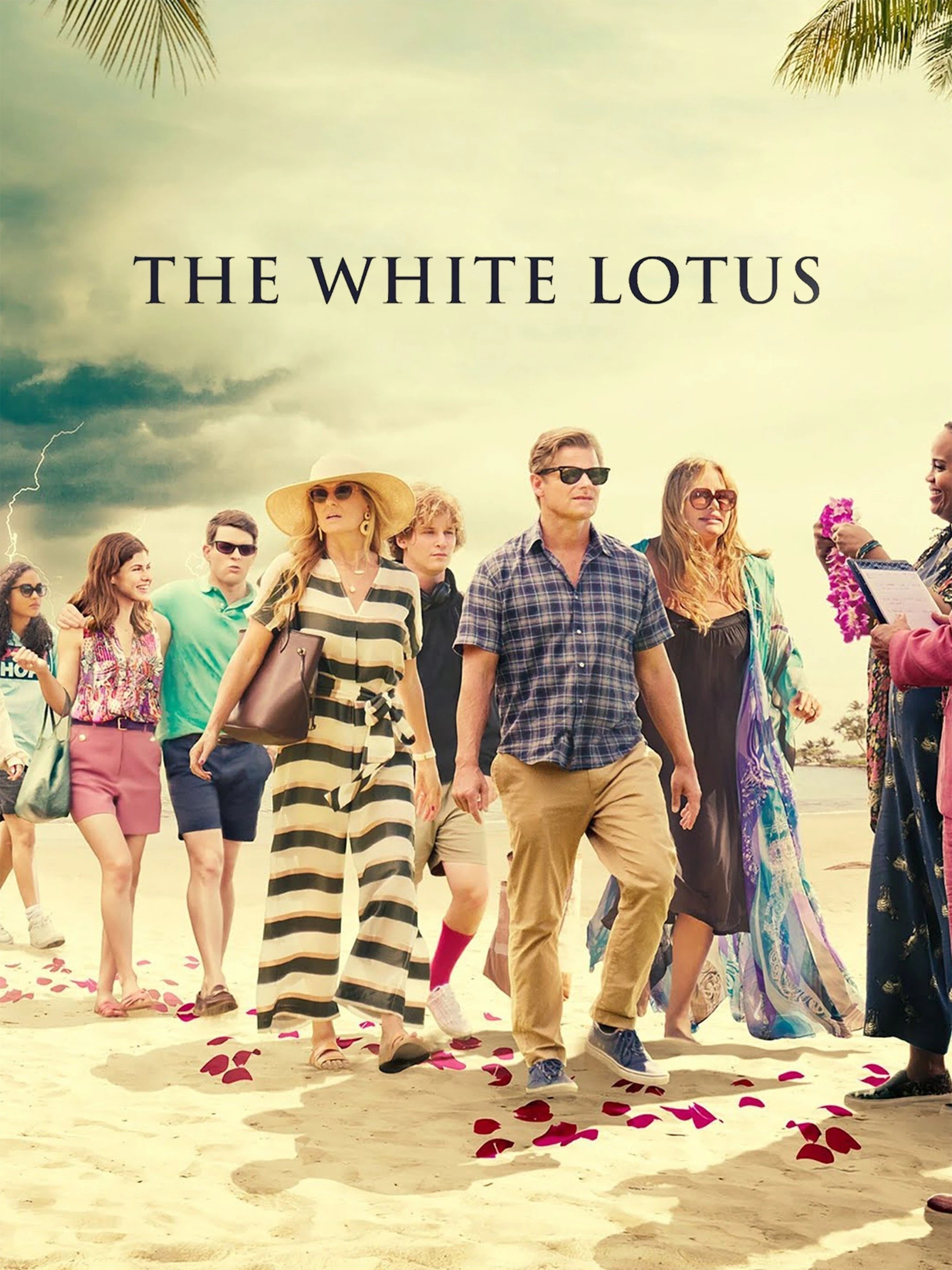
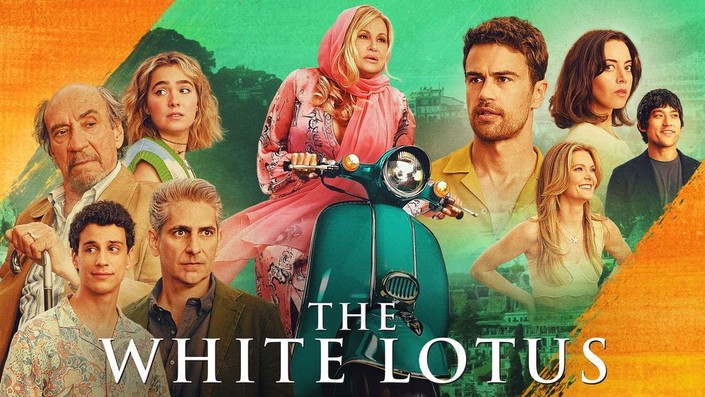
In case you have not noticed, The White Lotus is the multi-Emmy and Golden Globe award winning show launched on HBO (Home Box Office) in the US in 2021.  Now into its third season it has lost none of its momentum but rather gained in popularity and influence as a now record-breaking success for the channel, simultaneously broadcast outside of the US via Sky.  HBO is well known for its highly successful and influential “adult” dramas invoking much taboo, sexual and violent subject matter such as The Sopranos and Game of Thrones that, if it continues its run, The White Lotus perhaps looks set to eclipse.  It is the brainchild of Mike White, also known as a cinematographer, actor and occasional reality TV star, who writes, produces and directs the show in its entirety.  The show has received accolades for its writing, acting, and increasingly stratospheric production values and is praised as what one might loosely call its dark satire on particularly, yet not exclusively, North American forms of wealth and privilege. Its title plays upon the mythology of the lotus eaters who laze indulgently in a state of forgetfulness as well as its creator’s name.

Season One

It is interesting to question quite why it has had this impact and what, more exactly, sits at the core of its success.  I will suggest that this centres not on one rather a number of both thematic and episodic tropes and devices that entice the viewer and tap into wider cultural concerns.   These include its plot and narrative constructions; its cinematography; and its drilling of morality and ethical scruples through character driven psychological portrayals that centre most strongly on power and privilege, sex and sexuality, and death.

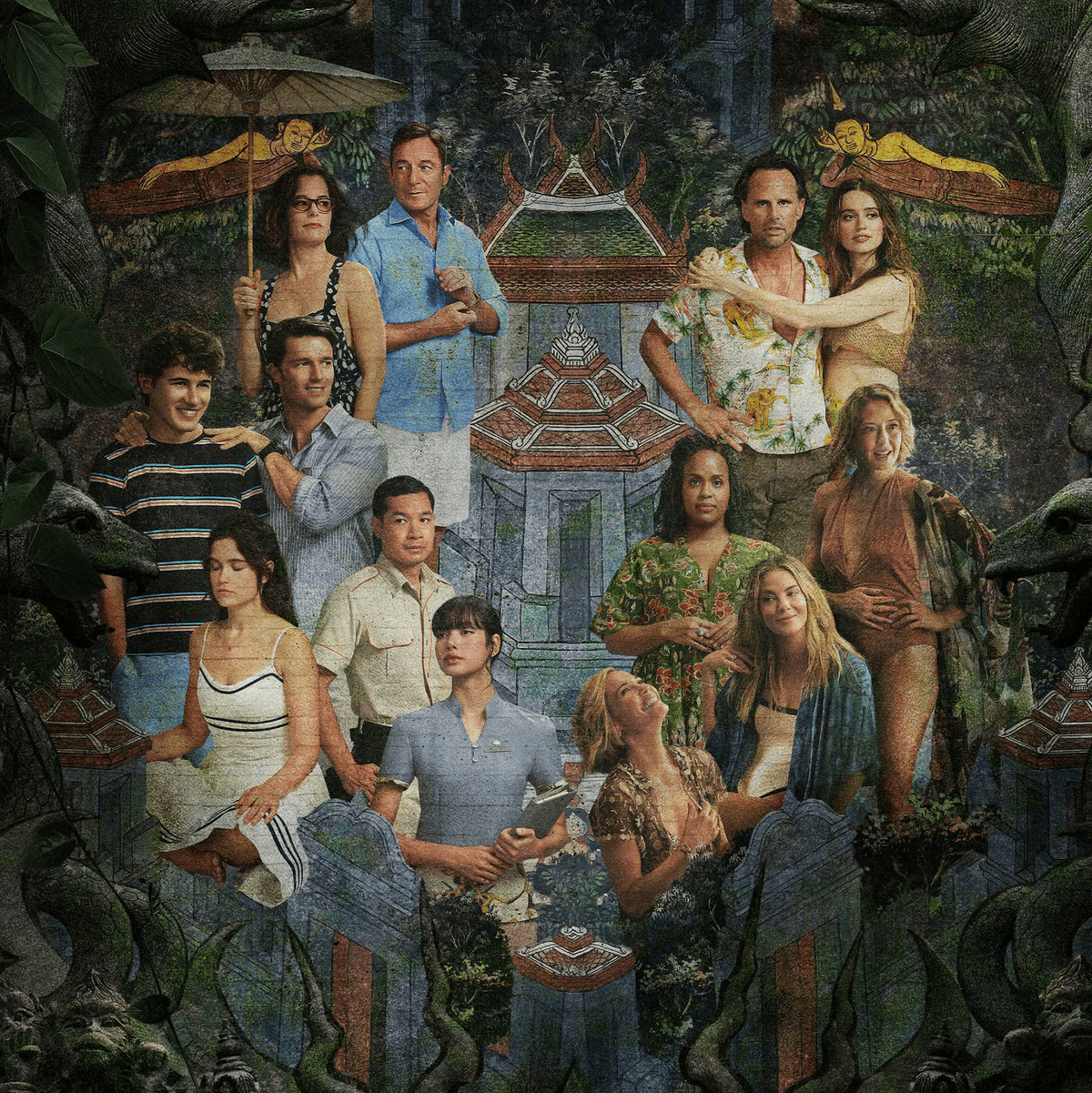
It is, on one simplistic level, a murder mystery thriller as each series opens with the death of a character (or characters) and then unfolds to eventually show not only who but rather how and why they die from a wider cast of holiday makers staying in luxury hotels.  The White Lotus itself refers to a chain of upmarket holiday residences in differing locations that change with each season so the first was set in Hawaii, the second in Sicily, and the third in Thailand.  Yet, interestingly, the series also scrambles conventional tropes of the murder mystery genre.  We do not know at the outset who has died, or even how many, who perpetrated the crime(s), or why, or even how.  It is not a whodunnit nor even a whydunit either rather a mix of all of these and, as some critics have pointed out, it is far too slow paced to work at this level alone.  The first series took up six near one-hour episodes, the second seven, and the third eight, the last of which was extended to ninety minutes.  In each case, at least half of the episodes are taken up with character building and, in the third, the climax is introduced in the penultimate episode, and then disrupted, only to return in the finale.  Thus, we think that Rick’s (Walton Goggins) “monkey is off his back” and Timothy’s (Jason Isaacs) suicidal killing spree is not happening, only to find that they reappear in differing forms with deadly consequences.

This disruptiveness is part of The White Lotus’s appeal; whilst infuriating for some, many more are kept on the edge of their seats.  Similarly, multitudes of plotlines are simply dropped or unresolved – how does Shane (Jake Lacy) get away with manslaughter in season one, just what is the connection between Greg/ary (Jon Gries) and a gang of gay hedonists in season two, and what will happen when Timothy’s family find out they’ve lost everything and he will likely end up in prison?  Minor story lines are often equally confused – does the truth of the robbery ever come to light in series one for the Mossbacher family beyond Olivia’s (Sydney Sweeney) suspicions, did Harper (Aubrey Plaza) have sex or just a snog with Cameron (Theo James) in season two, and who and what were the gunmen up to in series three as they were not the Russians?  These factors annoy some critics intensely and clearly have the potential to throw audiences off-track yet often keep more hooked for the following series.

Season Two

The show’s most complex plot straddles all series in fact – namely that of Greg’s seduction and, we presume, planned murder of Tanya.   She meets him in season one, they are married prior to season two, and in season three – following her death in season two – Greg (now Gary) collides with Belinda who was her masseuse in season one.  The fact that Greg (seasons one and two) Gary (season three) has turned up in all three seasons, and Tanya (Jennifer Coolidge) and Belinda (Natasha Rothwell) in two, adds to the sense in which it’s not all over when it seems over.  Moreover, the plotline here is extremely convoluted.  In season one, it appears Greg is unwell, yet this is never explained and is perhaps a ruse to get Tanya to marry him, whilst in season two he disappears early in the series to go on some kind of business trip but is overheard saying “she doesn’t suspect a thing” on the phone.  Tanya is then befriended by the openly gay but decidedly creepy Quentin (Tom Hollander) and his group of friends and cronies.  He takes her to the opera to see Madame Butterfly and arranges for her to have a lover for a night in his villa.  Her assistant Portia is meanwhile distracted – as part of the more murderous plot – by Jack to separate her from Tanya.  Tanya’s discovery of a gun and other paraphernalia on a yacht whilst on their return to the hotel confirms her suspicion that Greg is planning to do away with her as their prenuptial agreement means he will only inherit her fortune if she dies.  She then shoots and kills Quentin, as well as his cronies, yet falls to her death accidentally trying to get off the yacht onto a small boat that will take her to the harbour.   More obscurely, we are left to presume that Greg will now inherit her fortune and has “got away with it” in parallel to Shane in series one yet, in a further twist in season three, Belinda recognises Greg, now Gary, and becomes suspicious.  The now wealthy Greg attempts to silence her with money yet, in a twist that directly replicates season one in reverse, Belinda connives to attain more and rejects both the love and business proposition of her fellow masseur to pursue her fortune alone.  Preposterous as much of this is, it perhaps lends a feeling of reality to the fantastical show and its scenery.  Life rarely offers easy resolutions, a theme openly and directly expanded upon in the finale of season three, yet fans were left querying this final twist.  White appears to have felt the need to ameliorate the outcome that Greg may get away with murder and grants Belinda a cut of his success though, in so doing, her character has to perform a complete moral volte-face and reject a promising relationship. An underlying point, perhaps, is that wealth and privilege will turn even the most innocent. Yet it is perhaps White’s manipulation of the wider mise-en-scène that is key here, a theme I will return to later.

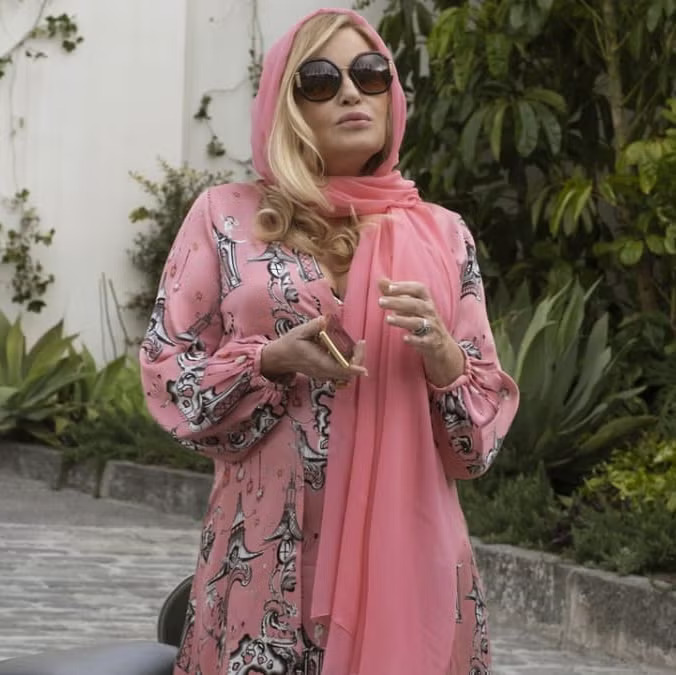
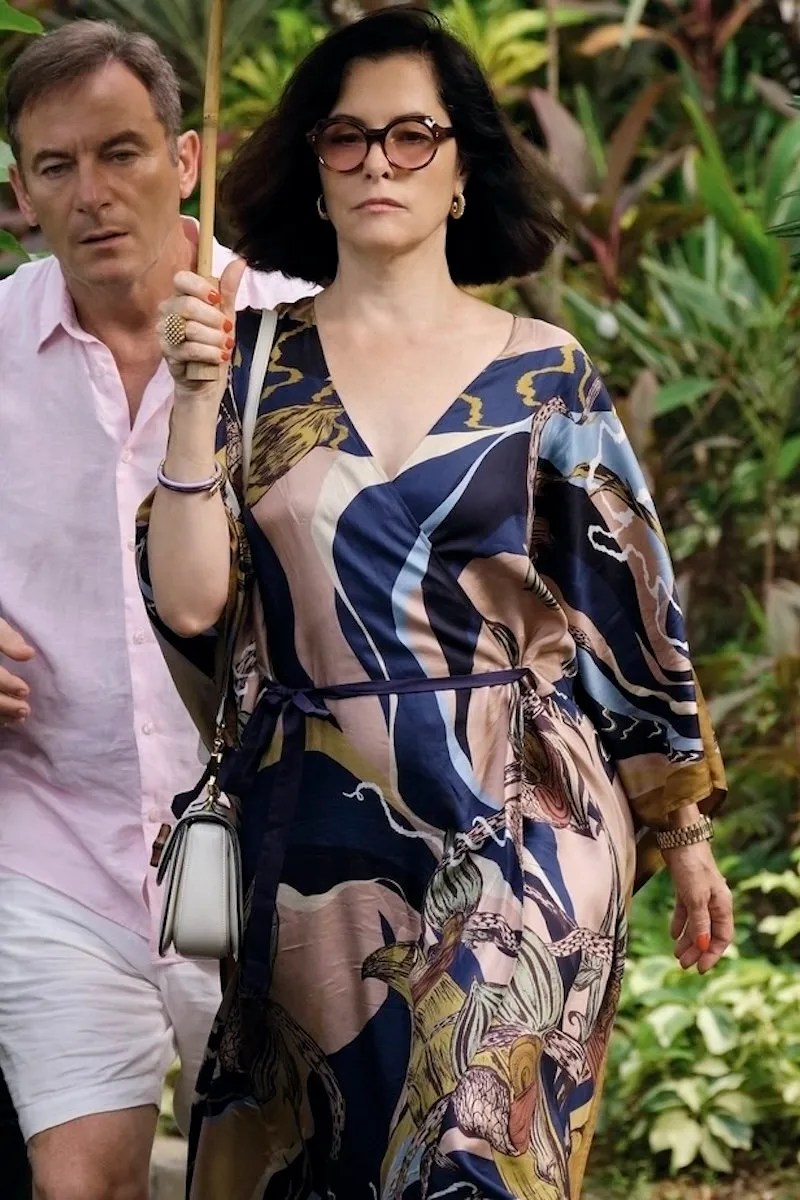
The White Lotus is also a show full of contrasts.  Far from being wholly serious, it is often highly, if rather darkly, humorous in places with various characters deployed to primarily comedic effect alongside wider satires on the peccadillos of the rich.  For example, the billionairess Tanya, who features in seasons one and two, is neurotic and self-obsessed, in one scene descending into a hysterical breakdown on a yacht that she has hired to scatter her mother’s ashes, much to the horror of her fellow travellers who are otherwise seeking a romantic dinner.  Similarly, in season three Victoria (Parker Posey) plays the wealthy yet prejudiced wife of a tycoon adopting an stylised Southern American accent to complain about “boat people” and “Buddhists” (pronounced boo-dist) explaining that the least one can do as someone highly privileged is to show the less fortunate that you enjoy it!

Season Three

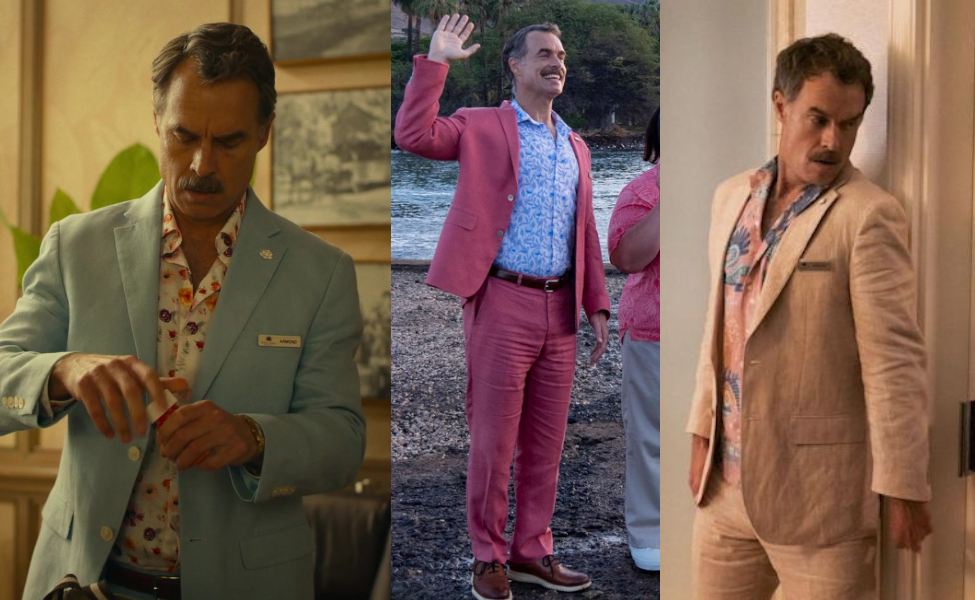
On the flip side, there is also much tragedy and unhappiness that emerges for almost every character.  Most major and some minor characters are explored in depth to reveal their hidden miseries and concerns from hotel managers – Armond (Murray Bartlett) in season one is a gay man recovering from drug and drink addictions whilst Valentina (Sabrina Impacciatore) in season two is a repressed lesbian – to their preposterously wealthy guests who worry about everything from testicular cancer to relationship problems and financial ruin.  Thus, there is a near relentless scrambling of genre going on where the audience is at once empathising with, yet equally horrified by, the characters presented who induce feelings of both fear and upset as well as ridicule.  Whilst most drama shows are keen to present characters who are complex and neither wholly good nor bad such contrasts in the show are often ratcheted up to a degree that is as unsettling as it is involving.  So, the audience is encouraged to sympathise with Armond as the pressured manager of oversized egos staying in his hotel whilst at the same time realising his self-destructive behaviours of stealing and drug taking are wrong – and, in relation to defecating in the suitcase, extremely funny – or to recoil in horror as Tanya’s egotistical demands increase yet empathise with her fragility and suffering.  This psychological “scrambling” has much to do with the show’s success.

The “Four-some” Season Two

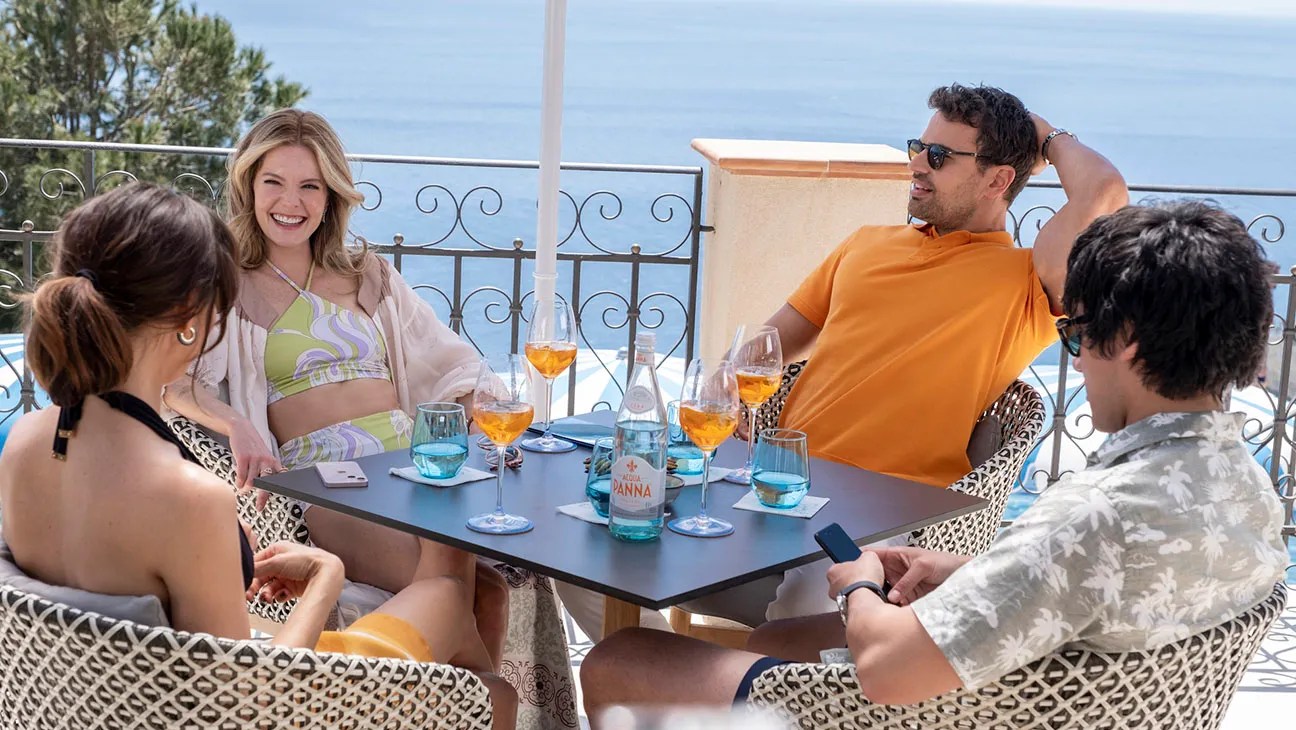
More significantly, plotlines here fling audiences around like a magnetised moral compass.  The foursome at the centre of season two, for example, invoke feelings of desire and disgust given their good looks and confused orientations – Cameron is arrogant and vain whereas his best buddy Ethan (Will Sharpe) appears guilt ridden and struggling with some kind of sexual impotence.  Underpinning this are themes of sexual jealousy and possessiveness that, even at the end, appear unresolved.  Will’s sudden amorousness towards Harper appears to follow a potential fling with Cameron’s wife Daphne (Meghan Fahy).   Similarly, even relatively minor characters are complex so that Jack (Leo Woodhall) swings from being a sexy Essex boy to a criminal with a background that alludes to him being groomed on the streets.  Similarly, the doe-eyed Mook (Lalisa Manobal) of season three turns out to be pushing her good natured and devoutly Buddhist boyfriend Gaitok (Thame Thapthinthong) towards aggression and killing.  It is this onion peeling of character and psychology that is so compelling, akin in kindness to the psychological thrillers of Hitchcock and Lynch yet is here framed within a TV series not film.

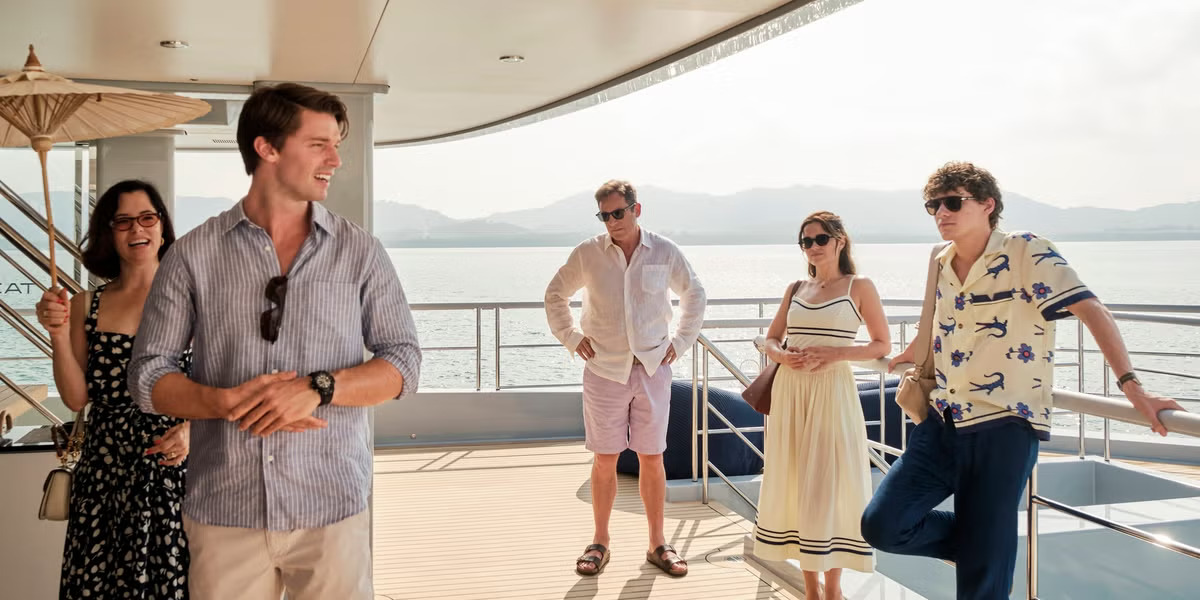
White is not averse here to the tricks of the reality TV genre, however, using sex in particular to titillate and draw in his audience.  Thus, in season one, Armond is caught cavorting – in fact rimming in full shot – one of his underlings in his office whilst the apparently heterosexual bad boy Woodall is caught buggering his boss Quentin, and all series feature one if not more (prosthetic or not) cocks on show.  What increases the amplitude here is that these are not necessarily minor characters or even throwaway plotlines rather Saxon (Patrick Schwarzenegger) in episode one of season three is watched desirously full frontal by his younger brother Lochlan (Sam Nivola) invoking themes that are not just incestuous but homosexual, a storyline that reaches its climax literally and figuratively during a drug-induced three-cum-foursome orgy mid-series, and this is a major part of Saxon’s unravelling.  Similarly, Cameron’s shorts dropping in front of Harper is the start of a plotline of “will they, won’t they” that becomes “did they, didn’t they” that dominates series two.   White’s own life history seems to play into this as both the son of a father who later came out as homosexual and as someone himself who is openly bi-or homosexual.  Perhaps more significantly, given the rise of conservative or even reactionary right-wing politics in the US, these shock style tactics also become jabs at the wider sexual hypocrisy that dominate parts at least of US culture.

As has already been stated, the series is primarily – if not exclusively – character driven.  There are interesting gender differences here, however.  Characters in any show are presented in three ways – first, through their appearance and dress; second through their actions and speech; and third, less directly through their interiority, silence, and expression.  For the most part, yet not totally, greater interiority is given to male characters – particularly in the more interior-focused season three – Timothy’s pain and suffering is a repeated trope shown on all levels including his recurrently horrified facial expressions.  This is a pattern repeated in his son Saxon who – in an ingenious piece of casting and playing by Patrick “son of terminator Arnie” Schwarzenegger – shifts from cocksure confidence to confusion and self-doubt.  By the same token, Gaitok is repeatedly presented through his “willing to please” smile that covers a multitude of internal terrors; whilst Rick is fully fleshed through his often-dishevelled appearance, perplexed expressions, and highly risk-taking actions.

Tanya (Jennifer Coolidge)
Victoria (Parker Posey)

By contrast, White has something of a fixation with making “rich bitches” the butt of his jokes.  This starts with the affectations and posing of both mother Nicole (Connie Britton) and daughter Olivia in season one and culminates in the figures of both Tanya in season two and Victoria in season three who become, in differing ways, resounding sources of humour whether for their childish howling (Tanya) or camp sneering (Victoria).  In fact, this sets up one of the difficulties of season three, namely that the three-character study of femaleness and friendship, only really comes together through Laurie’s (Carrie Coon) “at the table” speech (a near Emmy winning moment) in the final episode precisely due to this lack of interiority – the three of them are simply too indistinct.  In addition, White might be accused of setting up misogynistic stereotypes but his portrayals of both hotel manager Valentina and good time girls Lucia (Simona Tabasco) and Mia (Beatrice Grannò) as well as the suffering Portia (Haley LuRichardson) in season two offsets this let alone the tragedy of the kooky but immensely likeable Chelsea (Aimee Lou Wood) in season three.

Underpinning all of this is a recurrent theme – effectively and fully explored – of toxic masculinity starting with the utterly irredeemable Shane in season one.  He starts out by making unreasonable demands of the hotel and ends up murdering the hapless Armand whilst meantime consistently treating his new, young wife Rachel (Alexandra Daddadio) as a trophy for his mantelpiece.  More to the point, he gets away with all of it, including manslaughter, and his wife returns to him at the airport.  This is part and parcel of White’s scathing critique of privilege yet sets up a theme to which he will persistently return.  Cameron in season two is a good looking yet arrogant man on the make embroiled in competing with his best friend whilst, more significantly, the Di Grasso family are entirely composed of three generations of varying forms of masculinity – the “it’s natural” grandfather Bert (F Murray Abraham), the “recovering” sex addict father Dominic (Michael Imperioli), and the “guilt ridden” son Albie (Adam Di Marco).  Interestingly, none (quite) gets the girl.  The grandfather is too old, the father misses his wife and is desperate for her forgiveness, whilst his son is duped by a sympathetically portrayed, yet on-the-make, sex worker Lucia.  This moral complexity is played out in more depth in season three when the supposed archetype of successful masculinity (Timothy) unravels into a self-doubting and semi-suicidal mess that can do no more than appreciate the power of family by the end.  From here, his adoring son Saxon proclaims he is nothing without what his father has given him and gradually implodes in the wake of too much admiration from his younger brother Lochlan.  Thus, it would seem that – without invoking Donald Trump who is raised in conversation by the group of female friends – White concludes that the classic American ideal of masculinity is more simply a disaster waiting to happen.  Such tropes resonate strongly within and across contemporary culture and account for much of the show’s success.  Interestingly, alongside this, more than once White also invokes the figure of boyhood innocence in both season one when Quinn (Fred Hechinger) leaves his family to ride the waves and the whales with the other Hawaiian boat men and – in a moment of jaw wobbling emotion – Timothy, in tragically trying to spare the one “innocent” in his family, accidently near kills his son Lochlan then, in a further twist, saves him with a maternal style of love in a scene that has echoes of the Christian pieta in its presentation.  It is perhaps tempting to read this in terms of the over-cooked concept of “masculinity in crisis” yet there remains a strong sense of redemption in these story lines of finding nourishment in simpler ways of living.

Armand (Murray Bartlett)

As is becoming evident here and is otherwise well-known, The White Lotus shows are not merely entertainment or drama, but thematically multi-layered explorations of varying issues.  These both organise particular series and overlap across them.  For example, season one is dominated by themes of privilege and the struggles of the have nots (the hotel and other workers) in the face of haves’ immense wealth and power (the hotel guests).  If plotlines are taken to indicate “messages”, then the argument here is that privilege will always out – whether in terms of wealthy women who mislead their masseurs or money spinners who quite literally get away with murder.  Similarly, waiter Kai’s (Kekoa Scott Kekumano) failure to steal Nicole’s bracelet, in an attempt to reclaim a small part of Hawaii’s heritage from greedy colonialist hands, ends in disaster whilst Armond desperately tries to secure the hotel’s reputation yet is fired anyway.  What is thought-provoking here is that this could easily invoke frustration and fury for the audience yet the sense of moral complexity of both plot and character overtakes this.

Season two also interestingly inverts such outcomes as the workers, not the guests, are triumphant.  The good time girls Lucia and Mia get their money, Valentina is sexually liberated, and “rent boy” Jack carries on whilst the guests all end up fleeced, corrupted, confused, or dead.   At the centre of this is sex.  Sex in White’s narratives is a leveller, something that can render the powerful weak and the clear-headed confused.  At the centre of this in turn is identity – who exactly is zooming who?  These dark and murky themes ratchet up interest for audiences who attempt to morally evaluate what they see.

The parallel with reality TV is clear as already outlined yet what is more interesting here is White’s invoking of older and deeper, more literary – and indeed cinematic – explorations.  Ian McEwan’s novel The Comfort of Strangers (1981) explores the moral complexities of love and sex as a young couple find themselves victims of something more far more visceral in Venice.  Its more cinematic qualities were later developed as a film of the same name by Paul Schrader in 1990.   Whilst the psychological dramas of Hitchcock’s greats such as Psycho(1960) and Vertigo (1958) are easy reference points, another that underpins the third series in particular is Conrad’s turn of the twentieth century novella Heart of Darkness (1899), later the basis for Coppola’s critique of the Vietnam war in Apocalypse Now (1979), and resonant here.  An exploration of the hollowness and savagery at the heart of the civilised west is, in season three, juxtaposed with the ideas and teachings of Buddhism.  Whilst some characters are moved and confused – particularly Timothy, Saxon, and Lochlan – others such as Victoria are unmoved.  Similarly, those representing Buddhism itself do so in very mixed ways – Sritala (Lek Patravardi) is portrayed as an egoist screaming “kill him” at the end whilst Gaitok garners his promotion and gets his girl but at huge cost to his own moral compass.   Whilst some western characters become more sympathetic to Buddhism, Thai Mook for example echoes the western trope of the gold digging woman. Meanwhile, Suthichai Yoon as Luang Por Teera, a Buddhist monk, talks more sense than the rest of the cast put together.  The feeling here that all is far from well in the affluent west, materially and spiritually, is vast…

This thematic “goo” of morality, corruption, and redemption – in the wake of the hollowness of western extravagant consumption on lavish holidays – makes The White Lotus a rather religious show on more than one level.  Most of the major characters have lost, or are losing, their way as if to say that if organised faith fails in the wake of secularism, then other guidance is needed.  This is indeed a grandiose theme yet in a twenty first century dominated so far by wars, threats of terrorism, extreme greed and need, and day to day struggles to find meaning, it is one of immense redolence.   It is not surprising then that Laurie’s (Carrie Coon) paean to friendship in a long speech at dinner on how, aside from anything, we are all just on a journey with each other had most of its audience in tears.

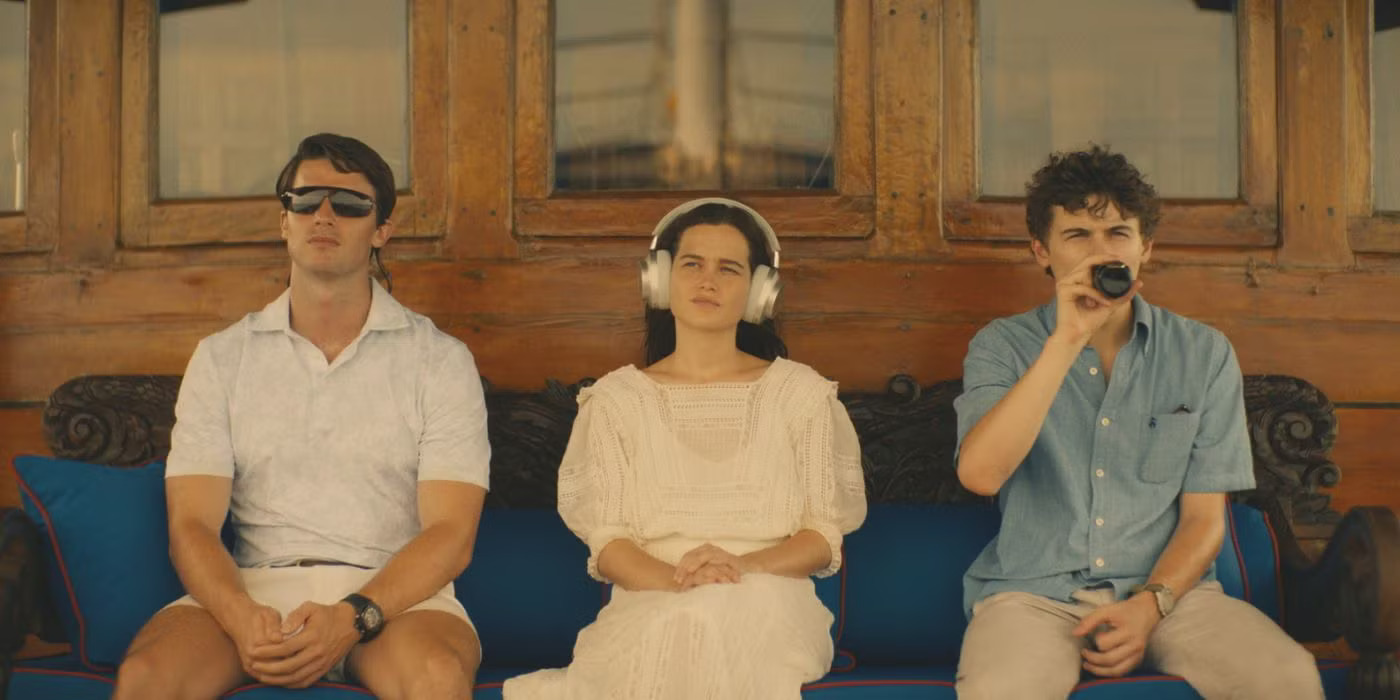
The Ratliff Family, Season Three including Saxon (Patrick Schwarzegger) 2nd left and Lochlan (Sam Nivola) far right

All of this so far focuses on the show’s content, characters and plots.  A final key aspect to its success centres on how it looks and sounds.  Whilst the production values of many shows since the inception of pay for streaming TV globally have risen immensely, The White Lotus is perhaps in a stratospheric league of its own, only matched by that invested in the fantasy genre.  There are two factors at work here.  One is that the shows are all shot on location where they are narratively set and the hotels are real, using access to various Four Seasons Hotel locations.  On top of this, White adds his own cinematic skill in amplifying equally the visual “wow” factor and more symbolic imagery.  Hence the sea is real yet then overlaid with visual effect.  In season one, Hawaii is portrayed as a water surrounded oasis, the water itself and the canoes and ocean wildlife feature strongly both visually and as a plotline for the escape of the deeply dissatisfied Quinn from the utterly dysfunctional Mossbacher family.  In season two, Sicily sizzles visually as a stunning landscape for its characters yet White adds recurring motifs through his use of murals, artwork, ornamentation and decoration of Greco-Roman style mythology – frescoes, paintings, and Mount Etna all feature – to illustrate the risks the charters face.  The effect, as in the visit of Daphne and Harper to a luxury ancient villa or in Tanya’s stay at Quentin’s mansion in Palermo, is to increase anxiety – or the spooky factor – in the onlooker.  More particularly, it plays into White’s handling of the death of Tanya that, directly and indirectly, is intentionally “operatic”.  She is taken to the stunning Teatro Massimo in Palermo to watch perhaps the most “tragic” and “heroine” centred of all operas, Puccini’s Madame Butterfly.  Operas are well-known for their tragic heroines and contorted plotlines, and it is this, rather than any verisimilitude of “reality”, that explains the convolution of the show’s core story.  Similarly, yet more so, season three sees Thailand awash with monkeys, snakes and lizards as well as verdant trees and shrubbery that themselves seem almost alive in what is clearly intended as a semi-pantheistic invocation of humans lost in nature.  The settings and their presentation echo the themes of the show and the internal worlds of the characters – the monkeys that chatter and disrupt, the sexualisation of the scenery that offers both possibilities to hide and be seen, and the ocean that constantly threatens to drown all in uncontainable emotion.  White’s skill here is perhaps unparalleled.  For example, in one of the key scenes of series three, a monologue by Frank (Sam Rockwell), heard and watched aghast by Rick, on the confusion of desire and identity of wishing to actually “be” a Thai girl fucked by his more masculine self, is set in a bar awash with glassy golden yellow walls and blurred shadow imagery that alludes to both problems of alcoholism and the moral ambiguity, if not even collapse, of the characters involved.  The scene was overly simplistically interpreted an exploration of Blanchard’s controversial conceptualisation of autogynephilic transsexualism yet is more accurately a study of the breakdown of Western identity in the face of challenges from more Eastern traditions and practices.  All shows in the series, as a matter of course, employ a more cinematic level of mise-en-scène with, for example, hotel décor echoing artwork used in the opening credits alongside a wider, hefty use of nature-based symbolism throughout.

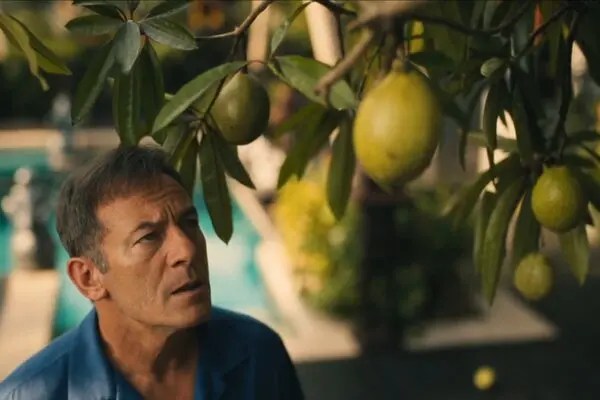
Timothy (Jason Isaacs) and “Pong Pong” Fruit

A similar statement may be made about White’s use of music in the show.  Working with long-time collaborator and musician Cristóbal Tapia de Veer, they come up with both theme tunes and sound effects playing on those theme tunes that play a large part in upping the “creepiness” and tension of many scenes.  Season two is littered with the use of classically Italian love songs – for example, Dean Martin’s That’s Amore sung at one point by Mia at the piano – yet Cristobal is Chilean Canadian and draws on a perplexing mix of both South American rhythmic and downright weird sound effects that often echo nature, animals, rhythms and disturbances.  In season two they are routinely paired with the imagery of mythology, art, and Italian frescoes to somewhat operatic “screaming” effect on occasion; whilst in season three, the music – prominent to the point of intrusiveness perhaps – adds to key scenes of character interiority and plot.  The repetitive and weirdly “breathy” refrain that is used in season three repeatedly occurs when risks of death are invoked, for example, in Timothy’s “not so pina colada” shake-making and delivering.  Whilst music is commonly used in TV shows, the level at which it is pitched here is more cinematic – akin to key scores such as say the use of Michel LeGrand’s piano in juxtaposition with imagery of deadly nightshade in Losey’s seventies classic The Go-Between (1971). Such a parallel in technique is not unfounded for the image and substance of the white lotus is constantly juxtaposed literally and symbolically with that of belladonna or deadly nightshade (even to the point of Timothy’s use of the cerbera odollam or “pong pong” fruit in season three).  Whilst the white lotus flower often represents spirituality, purity and transformation or reincarnation, belladonna symbolises not only literal death but desire, self-destruction, and implosion.  It is difficult to conceive of a more potent juxtaposition of imagery that, together with its complex plotting and character development, stirring of contemporary morals and profound thematic concerns, makes The White Lotus unmissable and resonant TV.

White Lotus
Belladonna (Deadly Nightshade)